AI Automation Shifts Knowledge Work Toward Harder Checks and Human Judgment
AI can make routine work faster while leaving people responsible for the decisions that are hardest to check. That shift deserves a place in any automation plan: time saved is only part of the result if workers must monitor quiet systems, review uncertain outputs and recover when a tool fails.
In 1983, University College London psychologist Lisanne Bainbridge described this pattern in “The Ironies of Automation.” Designers often automate tasks they understand, then leave operators with the tasks they cannot automate and the job of watching the system. Her analysis of industrial processes now fits teams working with AI agents. Automation changes human work; it doesn’t simply remove it.
A project estimate can count the hours a model saves. It’s less likely to count the attention required to supervise it. That omission matters because oversight includes verification and judgment, where misplaced trust can be costly. As a previous analysis of the cost of a successful task argued, the human effort spent recovering from failures affects the real cost of AI. The next question is what people do when the system succeeds.
Monitoring takes sustained effort
Watching an automated system may look like light work, especially when little happens. Research on vigilance suggests otherwise. A 2008 review by J. S. Warm, Raja Parasuraman and Gerald Matthews brought together behavioral, neural and self-reported measures. The findings point to sustained mental effort and stress: vigilance can carry a high workload, reduce engagement and increase distress. Monitoring is work even when it produces no visible output.
That leaves practical questions for teams adopting automation. Who monitors the system? How much time is assigned to the task? And can the person responsible stay alert when the system’s normal state is silence?
Generative AI makes those questions part of everyday knowledge work. In a 2025 survey, researchers from Microsoft Research and Carnegie Mellon University asked 319 knowledge workers how AI affected their critical thinking. Respondents said effort had shifted toward checking information, combining answers and keeping work on track. They described their own experience, so the results reveal perceptions rather than direct observation of behavior. Still, the pattern is clear: drafting may take less effort while review takes more.
Time savings can expand the workload
Research at a 200-person technology company offers a closer look at what happens in practice. Over eight months, Berkeley Haas researchers Xingqi Maggie Ye and Aruna Ranganathan studied employees with broad access to generative AI, drawing on observation and more than 40 interviews. They found that workers often used the time saved to take on more tasks, cover a wider scope and extend work across more hours of the day, sometimes without being asked.
The authors suggest that this expansion often came from employees themselves. The study covers one company and the work is ongoing, so it can’t establish a universal pattern. But it shows why a productivity gain doesn’t necessarily create more free time. Organizations and employees may turn faster execution into more output.
A randomized METR study raises a related issue: people may misjudge how much AI helps. Sixteen experienced open-source developers attempted 246 tasks in projects they had known for an average of five years. With AI tools available, they took 19% longer, yet afterward estimated that AI had saved them 20% of their time. The sample was small and the tools were those available between February and June 2025. Even so, the gap is a warning for teams that rely on user impressions to assess productivity.
Automation can weaken recovery and judgment
The harder question is whether shifting work toward review affects the quality of decisions. A 2014 meta-analysis by Linda Onnasch and colleagues combined results from 18 experiments. Greater automation improved routine performance, and workload fell while the automated system worked. When it failed, performance and awareness of the situation declined. The authors called this the “lumberjack effect”: the higher the trees, the farther they fall. Most participants across the experiments were students, a limitation when applying the results to experienced workers.
Expertise doesn’t automatically prevent overreliance. In a 2023 experiment published in Radiology, 27 radiologists read mammograms with assistance from a system presented as AI. More experienced readers were correct on 82.3% of images when the system was right, but on 45.5% when it was wrong. For less experienced readers, accuracy dropped from 79.7% to 19.8%. The findings suggest that a mistaken recommendation can sway specialists as well as novices.
A 2017 systematic review by D. Lyell and Enrico Coiera examined research on automation bias, the tendency to rely too heavily on decision support. Among 40 included studies, six concerned health care. The review found that automation bias can arise even in one-off tasks when verification is complex, and linked it to the cognitive load involved in making decisions. The authors suggest reducing that load as one way to limit the problem.
Taken together, these studies support a reasonable concern: automation may remove routine checks and leave people to handle exceptions, ambiguous cases and errors the system missed. Those remaining decisions may be less frequent but harder to spot. That interpretation hasn’t been directly measured as a general rule; it’s a risk worth examining when designing a workflow.
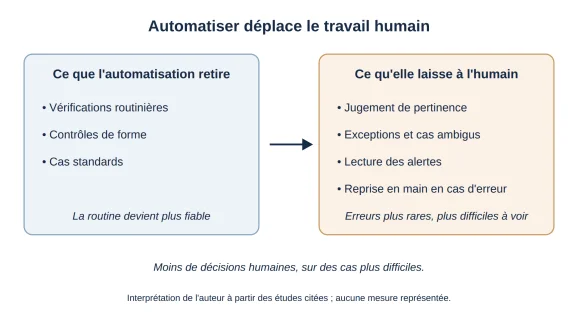
What automation removes and what it leaves behind. The author’s interpretation of the cited studies; the diagram does not represent a measurement.
AI can also ease real burdens
The evidence isn’t one-sided. Erik Brynjolfsson, Danielle Li and Lindsey Raymond studied a generative AI assistant introduced in stages to 5,172 customer service agents. The tool raised average productivity by 15%, measured in customer issues resolved per hour, but effects varied by experience. Less experienced and lower-skilled agents improved in both speed and quality. More experienced and higher-skilled agents became slightly faster while quality fell slightly. The researchers also observed better customer interactions: customers were more polite and less likely to ask for a manager.
A 2025 study in JAMA Network Open surveyed 263 clinicians across six U.S. health systems before and after 30 days using an AI scribe platform that documented consultations. The share reporting burnout fell from 51.9% to 38.8%, and cognitive load related to notes declined. The study had no control group, and three authors disclosed ties to Abridge AI, including two who were employees. Those limits matter, but the results point to a concrete benefit when AI takes administrative work off clinicians’ plates.
These findings fit with the automation research: workload can fall while a system works, especially when it handles a defined burden such as note-taking or suggests responses in a customer conversation. My read is that the attention cost depends on how work is divided. A tool that removes documentation may free up time; one that leaves a worker to scrutinize difficult, opaque outputs may create a different kind of burden.
What the research hasn’t settled
There’s no study cited here that measures whether effort per minute rises when people retain only judgment work. The idea is plausible, but the evidence is missing. Research directly measuring fatigue among employees who supervise workplace AI is also limited. One BCG study of 1,488 U.S. employees at large companies, published in Harvard Business Review, concluded that excessive AI use or constant monitoring can cause mental fatigue. BCG also advises businesses on AI transformation, so this is a signal rather than a settled finding.
Another gap concerns scale: the available sources don’t establish how workload changes when one person oversees more AI agents. That question is becoming increasingly relevant as companies assign multiple tools to a single employee.
Three questions for an automation plan
Teams don’t need to wait for perfect evidence to measure the work their systems create. Before automating, ask what will remain for people to check, whether those decisions are more difficult than the routine tasks being removed, and who will be responsible for review. Assign time for that work; without it, a review may become a sign-off in name only.
Then plan for failure. Who will notice when the system is wrong? Does that person have enough context and practice to take control? Productivity metrics should account for these responsibilities alongside output and speed. Time saved is valuable, but the work that remains determines whether those gains hold up in daily use.
For related reading, the free white paper The Hidden Bill for AI examines who checks AI output and how review, correction and supervision affect a project’s full cost.
Study quotations originally published in English have been translated by the author.
Sources
- Lisanne Bainbridge, “Ironies of Automation,” Automatica, 19(6), 1983, pp. 775–779: https://ckrybus.com/static/papers/Bainbridge_1983_Automatica.pdf
- J. S. Warm, R. Parasuraman, G. Matthews, “Vigilance Requires Hard Mental Work and Is Stressful,” Human Factors, 50(3), 2008, pp. 433–441: https://pubmed.ncbi.nlm.nih.gov/18689050/
- Hao-Ping (Hank) Lee et al., “The Impact of Generative AI on Critical Thinking: Self-Reported Reductions in Cognitive Effort and Confidence Effects From a Survey of Knowledge Workers,” CHI 2025: https://www.microsoft.com/en-us/research/publication/the-impact-of-generative-ai-on-critical-thinking-self-reported-reductions-in-cognitive-effort-and-confidence-effects-from-a-survey-of-knowledge-workers/
- Berkeley Haas, “AI Promised to Free Up Workers’ Time. UC Berkeley Haas Researchers Found the Opposite,” February 18, 2026, on ongoing work by Xingqi Maggie Ye and Aruna Ranganathan, also presented in Harvard Business Review: https://newsroom.haas.berkeley.edu/ai-promised-to-free-up-workers-time-uc-berkeley-haas-researchers-found-the-opposite/
- Joel Becker et al. (METR), “Measuring the Impact of Early-2025 AI on Experienced Open-Source Developer Productivity,” 2025: https://arxiv.org/abs/2507.09089
- Linda Onnasch, Christopher D. Wickens, Huiyang Li, Dietrich Manzey, “Human Performance Consequences of Stages and Levels of Automation: An Integrated Meta-Analysis,” Human Factors, 56(3), 2014, pp. 476–488: https://depositonce.tu-berlin.de/items/7df9879f-d77b-4f2b-8760-f0e3d174ca67/full
- Thomas Dratsch et al., “Automation Bias in Mammography: The Impact of Artificial Intelligence BI-RADS Suggestions on Reader Performance,” Radiology, 307(4), 2023, e222176: https://pubmed.ncbi.nlm.nih.gov/37129490/
- D. Lyell, E. Coiera, “Automation Bias and Verification Complexity: A Systematic Review,” JAMIA, 24(2), 2017, pp. 423–431: https://pubmed.ncbi.nlm.nih.gov/27516495/
- Erik Brynjolfsson, Danielle Li, Lindsey Raymond, “Generative AI at Work,” Quarterly Journal of Economics, 140(2), 2025, pp. 889–942: https://doi.org/10.1093/qje/qjae044
- Kristine D. Olson et al., “Use of Ambient AI Scribes to Reduce Administrative Burden and Professional Burnout,” JAMA Network Open, 8(10), 2025, e2534976: https://pubmed.ncbi.nlm.nih.gov/41037268/
- BCG, “When Using AI Leads to ‘Brain Fry,’” March 5, 2026, presenting Julie Bedard et al.’s article in Harvard Business Review: https://www.bcg.com/news/5march2026-when-using-ai-leads-brain-fry