AI Hiring Automation Shows Why Human Oversight Must Be Designed
Hiring’s automation spiral offers a practical warning for teams building AI agents: adding automation at each bottleneck can push humans out of decisions without making the process faster or safer. The answer isn’t to place a person somewhere in a machine-speed workflow and call it oversight. Leaders need to define where agents can act on their own, what human intent they must follow, and where a person must slow the process down. That requires looking beyond an individual tool’s performance to the pressures it creates across an entire process.
When automation feeds on itself
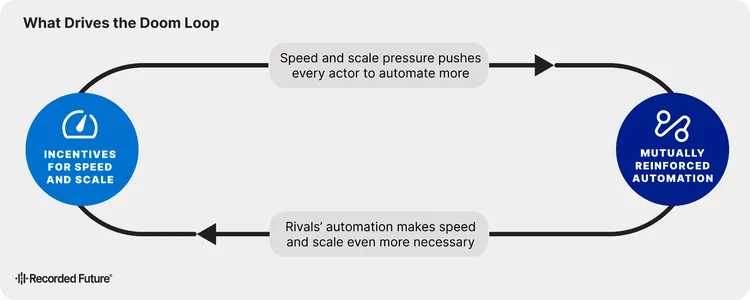
Hiring has long used software to handle application volume and support more consistent screening. Generative AI has changed the economics: candidates can produce tailored applications at scale, while employers use automated tools to manage the resulting influx. Greenhouse’s CEO has described the cycle as a “doom loop.” No single decision created it. Each side’s use of automation makes the other side more likely to automate too, turning a local efficiency measure into a system-wide response.
One survey of hiring managers found that applicants per hire tripled from 2021 to 2024. Greenhouse reported a 412% increase in applicants per job posting. Job seekers are almost certainly using generative AI to customize applications for hundreds of roles, adding more material for employers to process. Those figures describe rising volume, but they don’t show that the additional applications are better matches. For a candidate, sending more applications can seem like a rational response to an opaque process; for an employer, the same increase can look like a reason to filter more aggressively.
Employers have responded with more screening automation. 91% of HR departments report using AI in recruitment, while Greenhouse data shows that human recruiter numbers have fallen by more than half. The remaining recruiters face application volumes that make close review difficult. Some companies now use AI to conduct interviews, delaying applicants’ first contact with a human at a prospective employer until late in the process—or removing it altogether. The result can be a process with more automated decisions and fewer chances for either side to explain context or correct a misunderstanding.
More automation hasn’t delivered clear gains
The case for automating recruitment rests partly on speed and scale, yet the reported results are mixed. Only one-third of recruiters said AI had shortened time-to-hire; a quarter said hiring took longer. Some employers are extending probationary periods, suggesting they’re struggling to identify unsuitable candidates before making an offer. Job hunters have also voiced frustration at encountering bots instead of people. Taken together, those signals complicate the claim that automation reliably makes hiring more efficient: moving work into software doesn’t guarantee that the full process takes less time or produces better decisions.
There’s a difference between processing applications quickly and making a sound hire. A screening system may reduce the time spent on an early step while shifting effort elsewhere, such as to later interviews or longer probation. The available figures don’t establish why those changes are happening, so they shouldn’t be treated as proof that AI caused them. They do show why teams need to judge automation across the whole hiring process, rather than counting only the tasks a tool handles.
Automated screening also creates openings for abuse. Scammers and state-sponsored cybercriminals have exploited hiring processes to advance candidates seeking to steal secrets or cryptocurrency. A system optimized to process more applications can make it harder to distinguish genuine applicants from malicious ones. More throughput can mean more opportunities for a bad actor to enter the funnel, especially when each application receives less human attention.
Hiring was especially exposed because employers had already adopted tools such as keyword filters, and resumes and cover letters often follow patterns that generative AI can reproduce. That makes it relatively easy for applicants to tailor documents to what screening systems appear to reward. But the forces behind the cycle reach beyond recruitment: whenever one side can use automation to increase volume, the other side may respond by automating its own review.
- Pressure to move faster and reach more opportunities: competition rewards applicants who can submit more applications in less time. When each application takes less effort to produce, volume becomes a tempting strategy, even if it makes it harder to give each role careful consideration.
- Automation that reinforces itself: rising volume prompts employers to automate more steps, while applicants adapt their materials to satisfy the systems screening them. Each adjustment can make the other side’s next round of automation seem necessary.
What agent designers should take from hiring
The cycle turns a human hiring process into a contest between automated systems. Its wider lesson for AI agent design is that leaders need to account for the incentives and responses their systems create, including effects beyond their direct control. The useful question isn’t simply where to insert a human checkpoint; it’s which decisions can safely run at machine speed and which require human judgment before the system proceeds. This is more significant than it looks: an agent can meet its immediate target while making the surrounding process harder to manage.
That calls for clear boundaries. Teams need to decide what an agent may do without approval, what goals or constraints it must preserve, and what conditions should stop it for human review. A checkpoint only helps if the reviewer has enough context and time to make a real decision. If the workflow moves too quickly, or the person is expected to approve a steady stream of machine-generated actions, oversight can become a label rather than a meaningful control.
Here’s the thing: the human role has to be designed into the process, not added as a final formality. If you’re working in this space, ask what happens when users adapt to the system’s incentives, and whether that response will raise volume, lower trust, or make errors harder to catch. Similar systems typically need monitoring for those broader effects as well as for individual mistakes. Otherwise, the next efficiency improvement may simply push the bottleneck somewhere less visible.
And yet, automation can still be useful when it handles bounded, repetitive work and leaves consequential judgment with people who can examine the relevant context. That requires being specific about which actions are reversible and which could cause lasting harm. A system that can pause, explain its reasons, and hand uncertain cases to a person gives teams more room to correct course. A human in the loop, in name only.