How rOpenSci Turned Software Review Into a Professional Home for Mo
For Mo, rOpenSci’s value comes through in the work it makes possible and the people who make that work feel easier to join. A first software review grew into years of participation across package development, R-Universe, mentoring and community discussion. Her account, shared as part of rOpenSci’s 15th anniversary series, offers a practical view of how an open science community can support a research software engineer’s career.
Mo came to R through scientific work and gradually moved toward research software engineering. While still working in academia, she focused on tooling, analysis and data management with R. Joining rOpenSci felt like a natural extension of that path. She thinks Maëlle Salmon, a fellow member of the RLadies+ global team, first introduced her to the community. Her earliest interaction may have been a software review, after Salmon asked whether she’d be interested in reviewing a package.
That first step matters in Mo’s story because it gave her a way to participate through work closely tied to her expertise. Her first review was one point of entry into a community where technical contributions and conversation could lead to other roles.
A community that made participation easier
Mo describes rOpenSci as an easy community to join and stay involved in. She has found that suggestions, questions and requests for help tend to meet kind, collegial responses from people willing to share what they know. That tone had a direct effect: it made her more comfortable asking questions she might otherwise have worried were too basic, and helped her feel that her contributions counted.
That kind of welcome can shape how someone understands their own professional standing. Mo recalls being asked to mentor participants in the Champions Program. She had considered applying to be a Champion herself, but didn’t have the time available then. The invitation to mentor prompted her to reconsider her sense of her own expertise. Being asked to guide others helped her see that her experience could be useful in a different way.
Her involvement now spans a wide range of community work: software review, blog posts, collaborative tutorials, mentoring, package tooling development and discussion in Slack. She has also contributed to rOpenSci’s core packages and been involved with R-Universe.
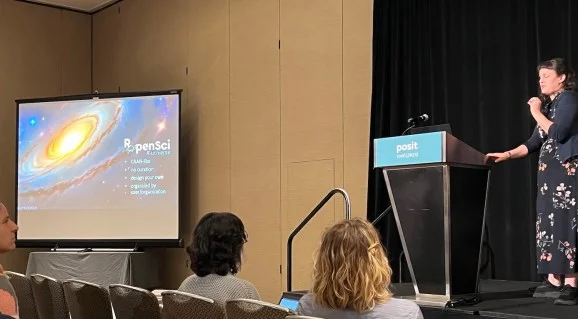
Mo delivering her talk about R-Universe at posit::conf
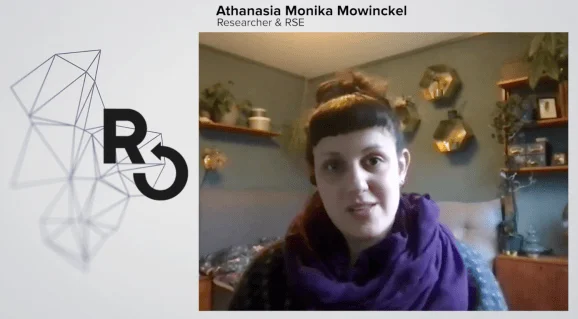
Interview with Mo for the series Star of R-Universe
Slack as the everyday expression of rOpenSci
Asked which part of the community best represents the rOpenSci experience for her, Mo points to Slack. It isn’t necessarily the busiest space, she says, but the activity is usually useful or enjoyable. She describes it as a friendly group of R enthusiasts who want to make things together.
That space also includes room for informal exchanges. Mo calls out the cat pictures shared in the cat channel, a small detail that captures the social texture of the community. For her, belonging isn’t limited to formal roles or technical milestones; it also grows through regular, low-pressure conversation.
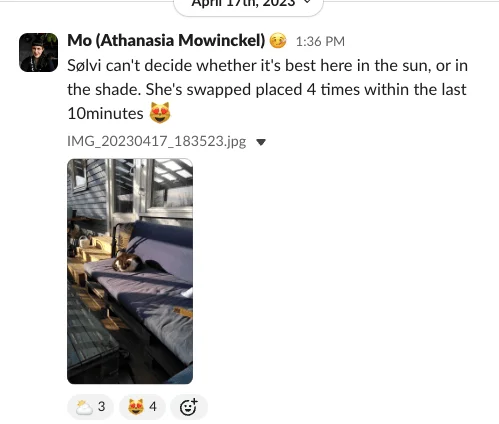
Mo’s message in the Slack channel rcatpeople
Mo’s view of what rOpenSci is for has stayed fairly consistent during her time in the community, though she suspects there have been smaller shifts that are hard to identify. The continuity she does describe is a culture in which people can ask for help, exchange knowledge and make contributions without needing to prove they already know everything.
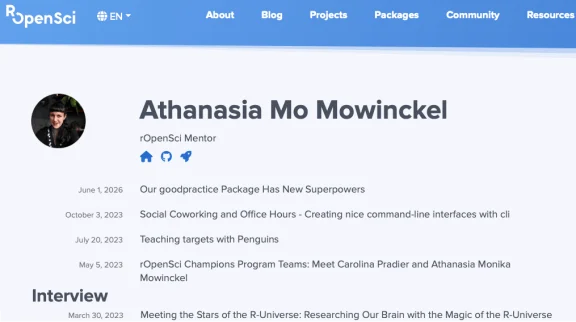
Mo’s author profile on the rOpenSci website
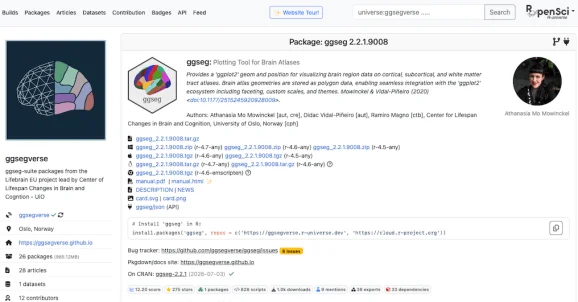
ggsegverse R-Universe
Peer support with professional value
Mo says she’s often surprised by how much she has taken on and where that involvement has led. She thinks of rOpenSci as a second set of colleagues: people who don’t work at her organization but are important to her work all the same. The benefit has reached beyond visible contributions. Alongside learning about mentor training and collaborative development, she has received feedback on funding applications and personal development projects.
Her experience is grounded in a few communities: rOpenSci, RLadies+ and The Carpentries. Mo says they share values around how contributors should be treated, which has given her confidence to participate openly. That experience has also helped her when interactions elsewhere have been less courteous.
She contrasts the atmosphere she has found in these groups with some experiences on Stack Overflow and social media. The difference isn’t just about comfort. In Mo’s view, people need to be able to ask questions without fearing they’ll be judged as incompetent. That sense of safety can make a community easier to enter and sustain.
Fifteen years in, rOpenSci feels to Mo like a second professional home: a place where she can ask for support and feedback, and where people will encourage her to continue even when no one has time to help immediately. The strongest takeaway from her account is that community participation can build professional confidence as well as technical skills.
A starting point for new contributors
For people discovering rOpenSci, Mo recommends getting in touch and starting wherever they feel comfortable. She singles out reviewing a package through the software review process as a useful first contribution. The work offers a chance to learn about reviewing others’ code, using Git and GitHub, and communicating with other professionals.
That path reflects Mo’s own experience: involvement can begin with one defined task, then grow as relationships and confidence develop. Her story suggests that the practical strength of an open science community lies not only in the tools its members build, but also in the conditions that let contributors keep learning and taking part.