rOpenSci at 15: Community Practices Shape Its Next Chapter
rOpenSci’s most durable contribution may be the community infrastructure around its R tools. At two online gatherings marking the organization’s 15th anniversary in June 2026, participants returned to the same point: peer review, documentation and coworking matter because people make them welcoming and useful. Their ideas for what comes next—from local meetups to better support for first-time contributors—build on that foundation.
The anniversary conversations, titled “rOpenSci Community Celebration: Then, Now & Next,” were held at different times to accommodate participants across time zones. A separate themed coworking event was also part of the celebration. Rather than present a formal history, the gatherings invited attendees to reflect on how they found rOpenSci, what it does well now and what they’d like to see it try next.
A format built for participation
Each gathering opened with a welcome and then moved through three 15-minute breakout rounds, one each for the past, present and future. Between rounds, attendees took part in a scavenger hunt, finding something nearby that matched a prompt. That small activity gave people an easy way to start conversations when they joined a new group.
The organizers also used a shared document for live note-taking. Participants could add thoughts during the event and keep contributing for a couple of days afterward. Noam Ross described this attention to how an event works—not just what it produces—as “process is product.” The format reflects a wider rOpenSci habit: make participation part of the work, rather than treating it as an add-on.
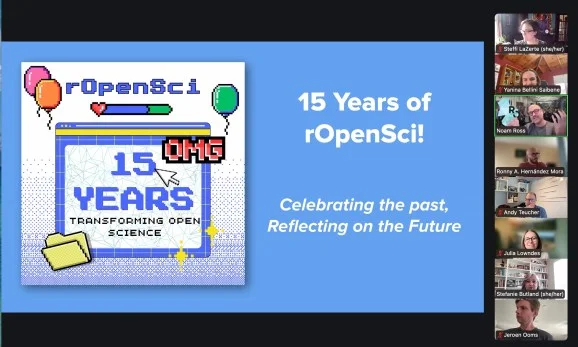
First event celebrating 15 years of rOpenSci
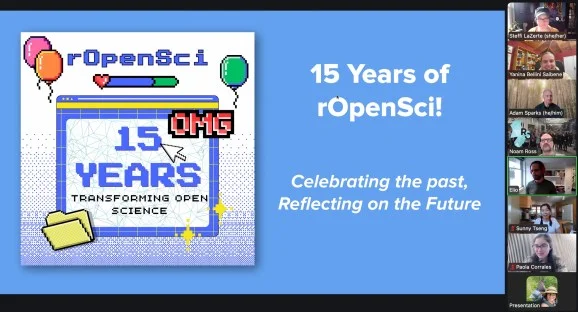
Second meeting to celebrate 15 years of rOpenSci
What brought people in—and kept them
Many participants first encountered rOpenSci through a talk or a personal introduction. The welcome they received mattered. That first connection could lead into a community whose best-known programs give people practical ways to learn, contribute and meet peers.
The unconferences drew especially warm memories. Attendees recalled sitting alongside other contributors, seeing how they worked and discussing R while ideas took shape. One participant summed up the appeal as “Meeting my heroes.” The value was both technical and social: people could learn by working together, while finding a place in a wider community.
rOpenSci’s software peer-review process also came up repeatedly. Editors, reviewers and package authors valued the quality of the process and the relationships it helped create. For Alex Koiter, being invited to write a blog post after an initial package review made them feel “very cool and a valued part of the community.” That experience points to a useful effect of review: it can open a path to further participation, as well as assess software.
Participants also singled out the rOpenSci dev guide, which gathers detailed, evolving advice that can be hard to find elsewhere. The Champions Program and mini-hackathons offer guided entry points for open source contributors and R package developers. Coworking sessions have a different but related appeal: they help people find peers who already understand the work.
Ronny Hernandez Mora described coworking as a satisfying “distraction/procrastination” from normal jobs—an activity that eases isolation and brings people from different worlds together on work that benefits others. The comment captures why community programs can endure even when attendance isn’t tied to a specific deliverable: the relationships are part of their value.
Welcoming culture as working infrastructure
Asked what rOpenSci does well today, participants most often pointed to its welcoming atmosphere. They connected that experience to specific parts of the organization: coworking, the Slack workspace, clear package submission documentation and the support available when someone takes on a role.
These aren’t just social details. Friendly spaces can help people ask questions, get advice and share ideas; useful documentation can make participation easier to approach. Several attendees noted that rOpenSci’s coworking model has also been adopted by other communities. The broader pattern is that community participation supports the quality of the work across different activities.
Some participants wanted to become more involved in the Champions Program, while also asking whether its entry points are accessible enough. That question matters because an invitation to participate only goes so far if newcomers can’t tell how to start. Adam Sparks described the community’s approach this way: “You can jump into a role and the community will support you. If there is anything you want to do, start doing it and you will get the support you need.”
Ideas for rOpenSci’s next 15 years
Participants’ suggestions focused on extending existing strengths and reaching people in more places. In-person and hybrid gatherings came up often: local meetups, local chapters, satellite events alongside larger R conferences such as useR!, and a return to unconferences, perhaps organized with other communities.
Other proposals ranged from practical contributor support to new areas of technical work. Participants raised the possibility of first-time contributor hackathons, potentially with a generative AI focus, and a 24-hour unconference modeled on formats used by groups such as SORTEE. Career panels could introduce the range of jobs in research software engineering and data-focused work.
One suggestion was an rOpenSci-led package for R package development, in the spirit of usethis, with support for GitLab, Codeberg and other platforms beyond GitHub. Attendees also proposed stronger coalitions with open science organizations, introductions between package authors and graphic designers, and exploring Zarr in R as an area where rOpenSci could help shape the ecosystem. Other ideas were more modest but still revealing: better support for people who are new to R, and rOpenSci merchandise, including its hex sticker. 
A harder question sat beneath several of these proposals: how can a community that has built carefully over 15 years respond to a faster pace of change? Generative AI was one example raised in discussion. Participants didn’t settle on an answer, but the tension between speed and care gives rOpenSci a concrete question to keep working through with its members.
Community is the connective tissue
The anniversary discussions suggest that rOpenSci’s tools and programs draw strength from the people who sustain them. Peer review, the dev guide, coworking and the Champions Program each serve a different purpose, yet participants described a common thread: they make it easier to contribute and feel that the contribution counts.
That helps explain why members’ future ideas span both technology and community design. Better support for beginners, first-time contributor events, local chapters and partnerships could bring more people into work that already has a strong social base. The recurring sentiment was simple: “It works because everyone is welcome.” 
rOpenSci’s anniversary events were part of a broader celebration series. The events calendar, anniversary blog posts and newsletter carry that conversation forward. The next chapter will depend on how the community turns its suggestions into ways for more people to take part.