Clinical Medicine Leads Stanford–Elsevier’s Top-Cited Scientist Rankings
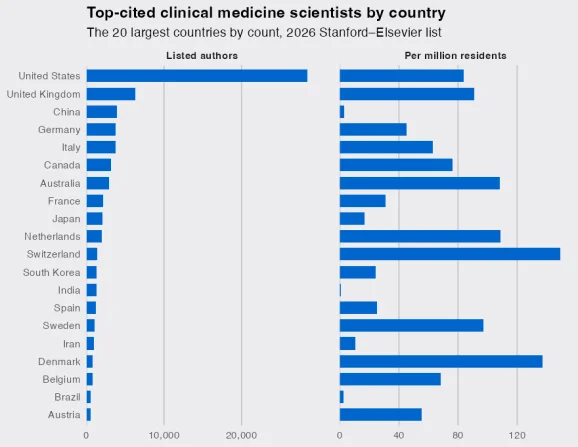
Clinical medicine accounts for nearly a third of the researchers in the 2026 Stanford–Elsevier top 2% author list, but country rankings shift depending on whether you count scientists or adjust for population. The United States dominates the raw totals. Switzerland and Denmark have the highest concentration of listed clinical medicine researchers per million residents among countries with at least one million people.
That distinction matters. A large research system can produce a high number of highly cited authors without having the highest density of them. The figures also reflect the mix of research fields within each country, so a clinical medicine ranking is best read as a measure of where listed authors work and what fields they represent—not as a universal score of national research strength.
The dataset behind the ranking
The analysis uses John Ioannidis’s science-wide author database, prepared with Elsevier from Scopus. The cited release is the August 2026 update, published as version 9 on Mendeley Data under a CC BY-NC 3.0 license. Its single-year table scores citations received during 2025.
Authors qualify by ranking among the top 100,000 on a composite citation score or placing in the top 2% of their main subfield. Each record includes a main field under the Science-Metrix classification and the country of the author’s most recent institution. That country field describes current institutional location; it does not identify nationality or where someone trained.
Clinical medicine is the largest of the 20 main fields in the list. It includes 76,155 of the 249,310 authors, or 31%—more than the next three fields combined. The size of the category makes its country breakdown especially useful, while also making clear that the results describe a specific citation based dataset rather than the full global medical workforce.
Counting authors in R
The calculation starts with the single-year Excel workbook from Mendeley Data. In R, readxl imports the “Data” sheet, and dplyr filters records to Clinical Medicine before counting authors by country. The workbook is about 100 MB, so the download timeout needs to be raised from its 60-second default.
library(tidyverse)
library(readxl)
url <- "https://data.mendeley.com/public-files/datasets/btchxktzyw/files/a517a94c-3fb0-4cee-b97f-f2d476df66f0/file_downloaded"
file <- "Table_1_Authors_singleyr_2025_pubs_since_1788_wopp_extracted_202608.xlsx"
options(timeout = 600)
if (!file.exists(file)) {
  download.file(url, file, mode = "wb")
}
authors <- read_excel(file, sheet = "Data") |>
  mutate(
    filled = is.na(cntry),
    cntry = coalesce(cntry, str_to_lower(top_cntry_career))
  )
clinical <- authors |>
  filter(`sm-field` == "Clinical Medicine") |>
  count(cntry, sort = TRUE) |>
  mutate(share = n / sum(n))
clinical
Two small implementation choices have a material effect on the result. The workbook opens on a column definitions sheet, so omitting sheet = "Data" reads the key instead of the author records. Also, 169 rows lack a current country value. The code fills those gaps with top_cntry_career, the country most often associated with an author’s papers, and marks each replacement in a separate filled column. Clinical medicine has 77 of the missing-country rows, more than any other field. This adjustment raises the U.S. count from 28,424 to 28,458.
The U.S. leads by total authors
After filling missing country values, the United States has 28,458 listed clinical medicine authors, equal to 37.4% of the field. The United Kingdom ranks second with 6,303, followed by China at 3,924, Germany at 3,770 and Italy at 3,710. Together, those five countries account for 61% of the category. The table includes authors from 147 countries, with 146 having at least one listed author in the reported country totals.
The gap between the U.S. and the next country is substantial: the American count is more than four times the U.K. figure. That reflects the scale of the U.S. research system in this database, though the raw count alone says little about how densely top cited researchers are distributed across a population.
Population adjustment changes the order
To compare concentration, the analysis joins the author counts to 2024 population estimates from the World Bank’s SP.POP.TOTL indicator. Countries with fewer than one million residents are excluded, avoiding results driven by very small populations. On this basis, Switzerland ranks first, with 1,345 authors, or about 149 per million people. Denmark follows with 820 authors and 137 per million.
The Netherlands places third at 109 per million, just ahead of Australia at 108. Sweden records 97.3 per million, the United Kingdom 91.0, and the United States 83.7. Canada comes next at 76.1 per million. The U.S. therefore ranks seventh under this measure, despite leading the absolute count by a wide margin.
China’s rate is 2.8 per million, while India’s is 0.9. The population threshold and data coverage both shape the comparison: without the threshold, Monaco’s three listed authors would put it among the leaders. Taiwan, which has 428 authors in the clinical medicine count, cannot appear in this per capita table because the World Bank source used here does not publish a population figure for it.
Field mix explains part of the gap
National totals across all fields help explain why China’s position in clinical medicine differs from its position in the overall list. China has 37,204 listed authors across every field, second only to the United States, which has 73,722. Yet China ranks third in clinical medicine. Only 10.5% of its listed authors have clinical medicine as their main field, compared with 38.6% in the United States.
Clinical medicine represents 34.4% of the U.K. list, 34.5% of Germany’s and 32.8% of Australia’s. Across the full database, the share is 31%. China’s largest field is Enabling & Strategic Technologies, with 8,807 authors. A country’s place in a field-specific ranking therefore reflects both the size of its research system and how its listed authors are distributed among disciplines.
These counts should be interpreted with care. The database ranks authors using citations, which are not a direct measure of research quality, and its authors caution against treating the list as definitive evidence of excellence. The country field also tracks an author’s most recent institution, with career country used to fill missing values; it is not a measure of citizenship or academic origin.
For researchers who want to inspect names or institutions, the full list is searchable at topcitedscientists.com, with a separate institution ranking. For analysts, the central takeaway is practical: pair absolute counts with population and field mix, and state clearly how missing affiliation data was handled. That produces a more useful comparison than a single country ranking can provide.