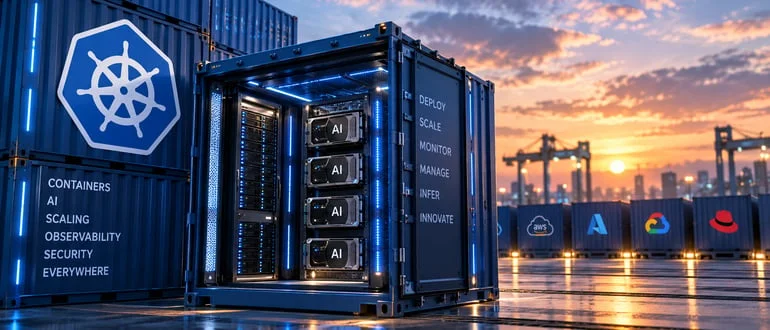
Kubernetes v1.37 Boosts Resource Management for AI and HPC Workloads
The latest release of Kubernetes, version 1.37, also known as Garhwal, showcases a notable leap in functionality with 67 enhancements—16 of which have reached Stable, 23 moved to Beta, and 27 marked as entering Alpha. A significant driver behind this evolution is the integration of declarative validation, which streamlined the handling of a record number of API reviews, totaling 118 pull requests, compared to just 88 in the previous version. This surge in contributions reflects the growing interest and reliance on Kubernetes in various sectors.
Understanding Declarative Validation
Declarative validation is a mechanism that allows developers to define validation rules directly within the API types, employing Interface Definition Language (IDL) tags in the types.go files of Kubernetes schema. This change is more significant than it looks; it boosts operational efficiency, as developers can now validate API inputs rapidly and accurately. Traditional validation processes often led to time-consuming error resolutions and debugging efforts. With this enhancement, Kubernetes reduces manual intervention, which is particularly beneficial when operating at scale.
By streamlining the validation process, Kubernetes enhances reliability across automated operations. Teams that deploy services can spend less time worrying about input validation and more time innovating solutions or enhancing service functionality. When systems become less error-prone, it not only enhances developer confidence but also improves overall service uptime—vital for businesses that depend on Kubernetes for mission-critical applications.
Kubernetes and Dynamic Resource Allocation
An area of particular focus in this release is Dynamic Resource Allocation (DRA), which enhances cluster operational efficiency, especially under the demands of large AI and high-performance computing (HPC) workloads. The DRA framework, already in general availability since version 1.34, has received significant upgrades to support more granular control over resource sharing and scheduling. This enhancement is aimed at diverse computational resources like GPUs and TPUs, which are frequently underutilized in traditional setups.
Among the new features is Node Declared Features (KEP 5328), allowing nodes to formally declare the specific resources they can provide. This capability is particularly valuable in heterogeneous clusters where nodes may have varying specifications and capacities. Supporting advanced capabilities like in-place pod resizing not only fosters more efficient workload distribution but also optimizes resource usage—an essential factor given the escalating costs associated with cloud computing.
For operations demanding substantial computational resources, DRA Group Claim Sharing (KEP-5729), now in Beta, facilitates multiple pods sharing a single resource claim, streamlining execution across multiple nodes in extensive jobs. This function significantly reduces the overhead of managing individual resource claims and can enhance throughput for resource-intensive applications.
Also highlighted is Gang Scheduling and Workload-Aware Preemption (KEP #4671), designed to address the challenges of scheduling for tasks requiring simultaneous pod deployments. This function is particularly critical for large-scale AI training tasks, where synchronization between workloads can greatly affect model performance. (and this is the part most people overlook) Without such coordination, workloads could suffer from performance degradation, wasting valuable compute cycles.
The introduction of the CompositePodGroup API (KEP #6012) in Alpha allows for complex workload descriptions that meet diverse scheduling needs. This change represents a robust framework for managing intricate dependencies that modern applications often require, marking a step towards making Kubernetes more adaptable to the specific demands of enterprise applications.
Control Plane Enhancements
Beyond resource management capabilities, Kubernetes v1.37 delivers substantial improvements in control plane stability and API scalability. Enhancements to lifecycle reporting will improve management protocols by offering better visibility into the states of nodes. This is a big deal: it includes indications for draining nodes or ongoing maintenance operations (KEP #5683), which can help DevOps teams plan interventions without risking performance or uptime. Such visibility simplifies troubleshooting and maintenance, making operations smoother.
To further strengthen compliance measures, the newly implemented Manifest Based Admission Control Configuration (KEP-5793) introduces file-based manifest configurations for initializing admission webhooks and policies through the kube-apiserver. This tweak vastly reduces opportunities for compliance bypasses and enhances security protocols, making Kubernetes deployments safer overall.
The v1.37 release cycle spanned 15 weeks, harnessing insights and developments from a diverse spectrum of 212 companies and 1,754 individual contributors. This collaborative effort underscores the communal nature of open-source projects and the importance of a broad base of contributors. Anticipation now builds for the next Kubernetes version expected later this year, promising to further the platform's capabilities and respond to an ever-growing suite of user needs.
Implications and Future Outlook
The updates in Kubernetes v1.37 represent more than mere patches or improvements; they encapsulate the current trends and aspirations in cloud-native technologies. With increasing dependency on AI, machine learning, and high-performance computing, Kubernetes is positioning itself as an indispensable tool for organizations looking to harness these capabilities efficiently. If you're working in this space, this shift could dictate how your teams approach deployment, scaling, and resource allocation.
In a broader sense, these enhancements reflect a shift towards embracing more sophisticated resource management strategies. As more companies transition to hybrid or cloud-native environments, the demand for flexibility and efficiency will only grow. Kubernetes, with each iteration, is making it clearer that it intends to meet these demands head-on. This evolution isn’t just about keeping pace; it’s about leading the charge into a more efficient future for enterprise computing.