365 Data Science Opens 134 AI and Data Courses for Free Through Nov. 20
A short window for a broad course catalog
For data professionals weighing where to build their next skills, 365 Data Science is opening its full course platform at no cost from November 5 through November 20, 2026. The offer spans 134 courses, practical projects and interactive exercises, with material ranging from foundational analytics to machine learning and AI engineering. That breadth gives learners options, but it also puts the burden on them to decide what’s relevant before the access period begins.
The short access window makes the initiative most useful for learners who arrive with a focus: a specific course sequence, a project to complete or a skill gap to address. The platform includes R programming alongside broader data and AI topics, and offers flexible access at any time during the promotion. A catalog this wide can be appealing, yet browsing without a plan can consume time that would be better spent working through lessons.
If you’re working in this space, it may help to start with a task you want to perform—such as analyzing a dataset or building a visualization—and then choose courses that support it. That approach gives the promotion a practical purpose, even if the access period isn’t long enough to cover every topic that catches your eye.
Explore the 365 Data Science platform.

A larger annual access initiative
This is the sixth year of 365 Data Science’s Free Access Initiative, which began in 2020. The company says its 2025 edition drew more than 220,000 unique learners across 216 countries. Participants logged 7.2 million minutes of learning and earned more than 36,000 certificates.
Those figures show the initiative’s reach and the amount of activity recorded during the previous edition. They don’t, on their own, indicate how much learners retained or whether the certificates affected their job prospects. For prospective participants, the more immediate question is whether the courses match a skill they can use and whether they can devote enough time to complete them.
CEO Ned Krastev points to demand for AI skills as a reason to broaden the initiative’s focus. He says rapid changes in AI and data are creating opportunities for career growth for people prepared to work with new technologies. That’s the company’s case for putting AI topics alongside more established data coursework.
Krastev also says the company wants learners to progress from data literacy into practical work with AI systems, including building, deploying and integrating them. The platform’s material covers AI engineering and intelligent agents, which the company describes as systems able to reason, plan and act autonomously. Those terms cover a wide range of tools and techniques; learners should check individual course outlines to understand what each one actually teaches.
Courses, projects and credentials
The 134-course catalog covers data fundamentals through machine learning, AI and AI engineering. Learners can reinforce course material with guided challenges and interactive exercises, then apply concepts in projects modeled on practical work scenarios. That mix can help connect instruction to a task, though a project description alone can’t establish how closely it resembles a learner’s workplace.
Structured learning paths provide a sequence for people working toward career goals, from beginner-level study to job preparation. A sequence can make a large catalog easier to navigate by showing which material comes first and what may follow. Learners still need to judge whether the path fits their starting point and the skills they’re seeking.
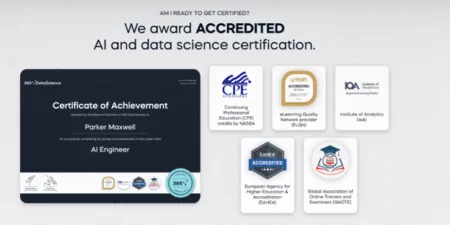
The initiative also includes certificates at no cost. 365 Data Science says these credentials validate skills in areas such as analytics, AI and machine learning, though their value to employers will depend on the role and hiring context. A certificate can document course completion; it can’t replace the ability to explain how you applied the material or demonstrate that work.
R programming in the catalog
R has a dedicated place in the course selection, particularly for analysis and visualization. The three listed courses offer different entry points, from learning the language’s basic operations to using it alongside other tools or applying it to business cases. That range may suit learners who want to sample R before committing to a longer study plan.
- Introduction to R Programming covers syntax, data structures and core operations for learners starting with the language.
- The Complete Data Visualization Course with Python, R, Tableau, and Excel teaches visualization across several tools, including R.
- Data-Driven Business Growth applies R to business cases and the use of data to inform growth decisions.
Related coursework includes statistics, probability, statistical testing in sales and marketing, and data preprocessing. These subjects provide context for the decisions made during analysis: how data is prepared, what a statistical result can show and how findings are presented. Pairing R practice with those methods may be more useful than treating the programming language as a skill in isolation.
Still, three listed courses don’t tell the whole story about depth, teaching style or the amount of practice involved. Learners considering R should review the course descriptions and decide whether the material fits their current level. A clear starting point matters more than trying to cover every related topic within a limited window.
What the offer means for learners
This is more significant than it looks for someone who’s been putting off a first course: removing the price barrier makes it easier to test a subject before deciding whether to pursue it further. But free access doesn’t remove the costs of time and attention. The offer’s value will vary with each learner’s schedule, goals and prior experience.
Similar online learning programs typically ask learners to manage their own pace, so a short promotion rewards preparation. (And this is the part most people overlook.) Picking a single course or a short sequence ahead of time can make it easier to distinguish useful progress from simply sampling lessons.
There’s also a practical difference between learning a concept and being ready to use it at work. Projects and exercises can give learners a chance to apply course material, while structured paths can help organize study. Neither guarantees job readiness; the outcome depends on what the learner practices and how well the work fits the role they have in mind.
Making the access window count
Free access is available from November 5 to November 20, 2026. Given the limited period, learners may get more from the offer by identifying a target in advance: for example, completing an introductory R course, trying a visualization project or following a sequence into machine learning. A modest plan is more realistic than expecting to master several subjects in a fortnight.
The initiative brings a wide catalog within reach for a short time, with projects and exercises that give learners ways to apply the material. Its practical value will come down to choosing relevant coursework and making time to finish it before access ends. The catalog’s breadth is useful; the numbers here are underwhelming as evidence of learning outcomes, since participation and certificates don’t show what learners can do afterward.
For readers weighing whether to take part, the simplest test is whether there’s a course that connects to a concrete goal. If there is, the access period offers a chance to start without paying for the course. If not, the large catalog alone may not be enough reason to spend limited study time browsing.