Essential Tools for R Package Management: Streamlining Your Development Process
The R programming ecosystem is currently witnessing a remarkable surge in package and environment managers. This uptick presents a treasure trove of options for R users, providing an array of sophisticated tools. However, the increasing number of choices can be overwhelming. Personally, I’ve had my share of challenges keeping up with all these tools and deciphering their unique functionalities. It's not just about picking a tool; it’s about understanding how they fit into specific workflows.
Diversity of Tools in R Package Management
I can’t be the only one grappling with the complexities of these options. In a recent Data Science Lab session I co-hosted with my colleague Libby Heeren and Eric Nantz, we primarily discussed {rix} and Nix. But a significant portion of the audience’s inquiries centered on how {rix} compares to other tools like {renv}, rv, and uvr. This overwhelming curiosity highlighted the necessity for clearer insights into these options, which are becoming increasingly vital for effective package management. To that end, I've compiled a brief overview of five notable tools: {renv}, {rix}, rv, uvr, and ir.
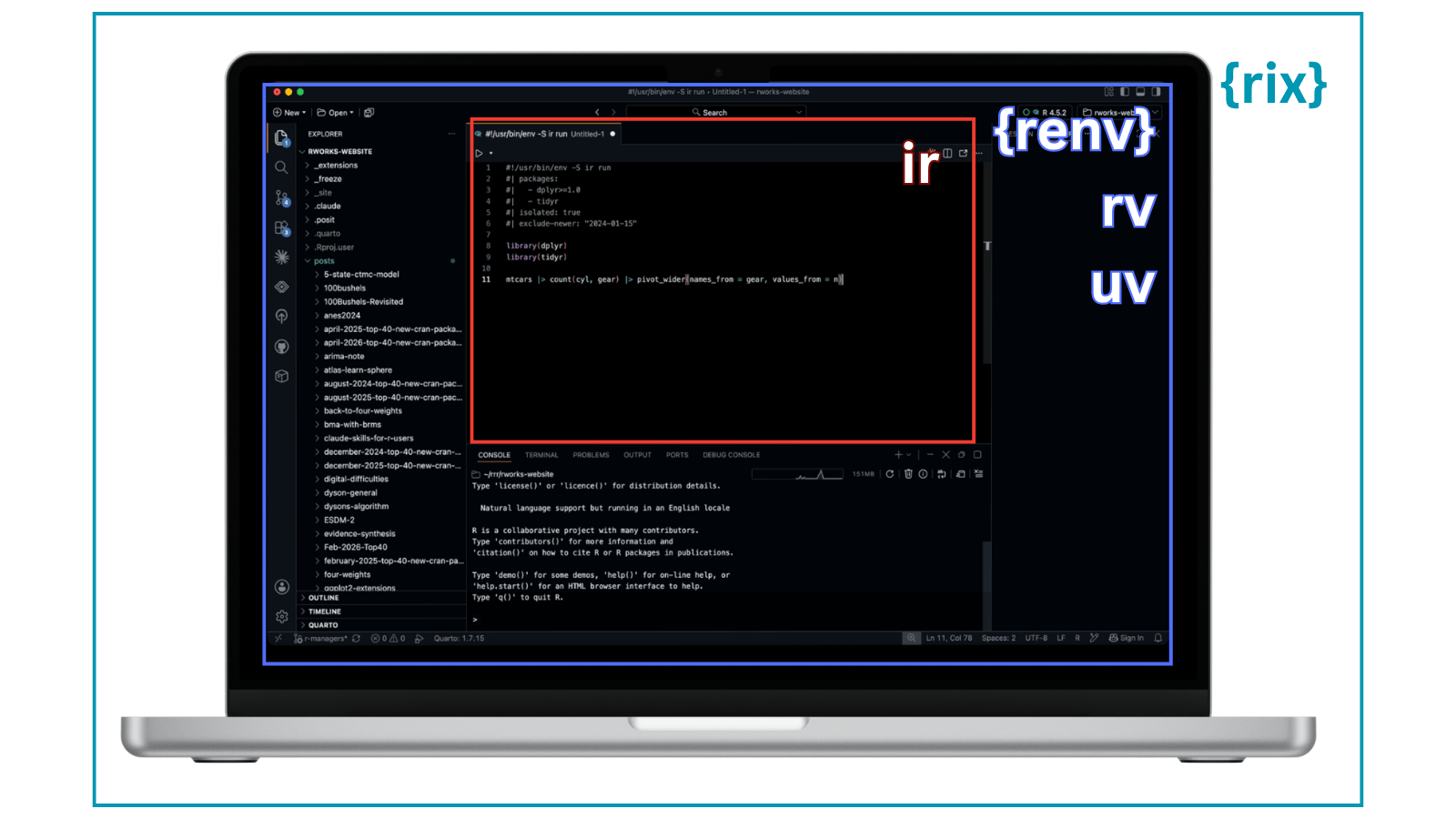
Each of these tools focuses on managing or isolating dependencies, though they function at distinct operational levels:
- {rix} captures the entire system environment in its snapshots, giving users a comprehensive view of their R ecosystem.
- {renv}, rv, and uvr maintain R package dependencies specifically within individual projects, ensuring that projects are insulated from changes made globally.
- ir simplifies dependency management for a single R script, making it ideal for ad-hoc analyses and quick experiments.
I hesitate to declare which tool reigns supreme or even offer personal endorsements. The truth is, I haven't yet engaged with all of them in meaningful, real-world scenarios. That’s my diplomatic way of saying I need more hands-on experience. But I’m genuinely curious to hear which tools resonate best with you! 
Popularity Indicators: GitHub Stars
While it’s not a definitive measure of quality, take a look at the GitHub stars for these tools, which can shed some light on their relative popularity among users. Popularity metrics like these often influence users’ choices when selecting a tool, even if they don't always correlate with performance.
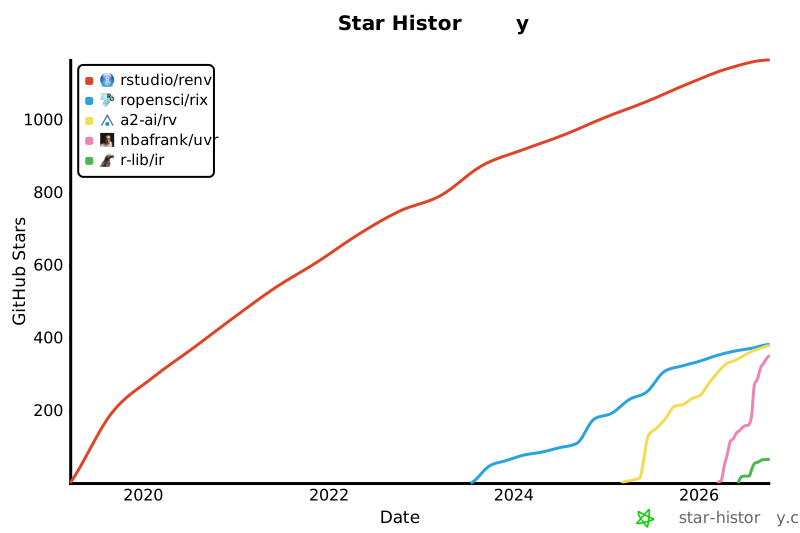
That’s where recency bias plays a role—you might want to tread carefully when interpreting these figures. A few stars one week won’t necessarily indicate long-term sustainability or usability.
Looking Ahead: The Future of R Package Management
The emergence of tools like uvr and ir marks a substantial shift in how R developers manage packages and environments. As the ecosystem becomes more intricate, maintaining a reliable workspace for projects—whether they’re large-scale or focused on single scripts—has never been more critical. This trend suggests that users can now choose tools tailored to their specific workflows and project requirements, allowing for a more personalized development experience.
What stands out is the ease of reproducing environments and sharing code. With uvr's project management capabilities and ir's streamlined approach for single-file scripts, developers can sidestep the "it works on my machine" syndrome. This is particularly pertinent in research, where reproducibility is not merely a convenience—it's a necessity.
And yet, challenges remain that can't be ignored. The rapid development of these tools might lead to fragmentation within the ecosystem. While we celebrate their flexibility, we must contemplate how we can unify and integrate disparate tools into an efficient workflow. The current pace of innovation suggests that more advancements are forthcoming, but we should advance cautiously concerning compatibility and overall ecosystem cohesion.
If you're working in this space, keep an eye on the evolving dialogue surrounding these tools. They’re not just reshaping how we think about our coding environments; they could also alter how we approach collaborative projects. Whether you’re a seasoned developer or just starting, being informed about these developments will undoubtedly pay off. The future of R coding looks promising. Just remember—the real challenge lies in finding the best way to harness these tools wisely.