Exploring Research Software Interoperability at BioFAIR CoFest
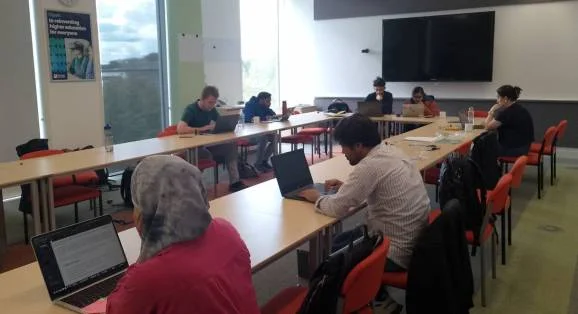
From September 15-17, 2026, an energetic gathering took place at The Open University in Milton Keynes, uniting members of the Bioconductor, Galaxy, and nf-core communities for the BioFAIR Data to Discovery and BioFAIR Collaboration Fest (CoFest). This collaborative event featured intensive training sessions alongside collective efforts focused on enhancing the interoperability of research software.
Pioneered by BioFAIR Fellow Marisa Loach and BioFAIR Pathfinder project lead, Kevin Rue-Albrecht, the event welcomed participants from the UK, Ireland, Germany, India, and the USA, offering a hybrid format that allowed both in-person and online engagement.
Marisa led a session on Data to Discovery, introducing attendees to single-cell analysis using the European version of the Galaxy platform (https://usegalaxy.eu/), while Kevin guided efforts in the CoFest aimed at enhancing accessibility of methods developed within Bioconductor, notably through systems like Galaxy and nf-core.
Navigating the Challenge of Reusability
The bioinformatics landscape encompasses multiple communities focusing on distinct elements such as code creation, non-code GUIs, tutorial generation, and documentation. Bioconductor serves as a vast ecosystem for R packages implementing analytical methods; Galaxy offers an accessible platform for executing and sharing reproducible analyses; nf-core establishes a community structure for portable Nextflow pipelines.
Despite these complementary roles, enabling the same analytical methods across these environments requires diverse wrappers, metadata, and ongoing maintenance, a logistical hurdle that the BioFAIR Pathfinder project is scrutinizing to minimize duplication. This includes tools designed to adapt Bioconductor methods for compatibility with Galaxy tools and nf-core modules.
A major emphasis during the CoFest revolved around BiocJobs, a concept being crafted to align analysis tasks with Bioconductor packages, facilitating the generation of representations for various workflow systems.
Translating Ideas into Action
Rather than just engage in abstract discussions about interoperability, attendees implemented the concept through an exemplar single-cell analysis workflow. Participants mapped segments of this workflow to reusable package-level ‘BiocJobs’ and tested the journey from maintained package descriptions to the creation of workflow components. The activities included data import, quality control, normalization, dimensionality reduction, and marker analysis.
This practical approach not only allowed contributors to concretize the process but also refined documentation and pinpointed requirements to ease future contributions.
By the event's conclusion, the workflow they'd collaborated on was encapsulated in a diagram illustrating the transition from a Bioconductor package repository commit to the automatic creation and dissemination of tool wrappers for platforms like Galaxy and nf-core.
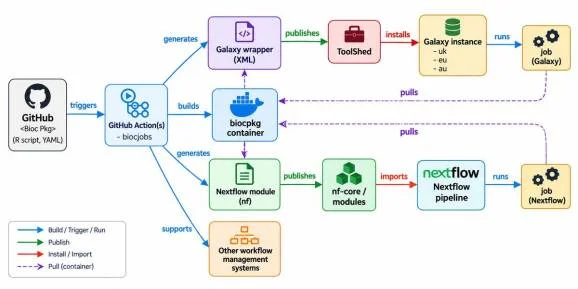
While three days proved insufficient to realize the entire workflow depicted, the CoFest effectively established a foundation for onboarding new contributors, streamlining the pathway for generating more wrappers for popular Bioconductor methods over time.
Insights Gained
A key takeaway from the event was the understanding that interoperability extends beyond merely building software links between platforms.
It's equally about determining where information resides, who oversees maintenance, and how contributions integrate smoothly into each community's practices. The collaboration of Bioconductor developers, Galaxy contributors, and nf-core developers enabled a holistic examination of the process, rather than viewing it through the prism of an individual ecosystem.
Clearing proved beneficial as participants worked through a tangible scientific use case. By focusing on a real single-cell workflow, attendees had a common reference point for building, testing, and discussing, which also revealed challenges that might have been overlooked in theoretical discussions. The CoFest notes highlight numerous questions that emerged, particularly concerning the structure and composition of reusable jobs.
Looking Ahead
The CoFest was seen as an initial step rather than a conclusive sprint.
Next, the focus will move to refining the showcased workflow: improving tools and documentation, assessing it against more Bioconductor methods, and simplifying the process for new contributors to participate.
Plans are also in motion for subsequent events in early 2027, offering another chance for community collaboration, progress on examples from Milton Keynes, and engaging more contributors in expanding this approach to other prevalent methods.
The overarching goal is clear: enhance the ease with which software crafted in one research context becomes a significant, sustainable asset in another.
If you're interested in participating, consider joining the Bioconductor Zulip and the #biofair2026-workflow-sprint channel to stay connected with ongoing discussions.
© 2026 Bioconductor. Content is published under Creative Commons CC-BY-4.0 License for text and BSD 3-Clause License for any code. | R-Bloggers