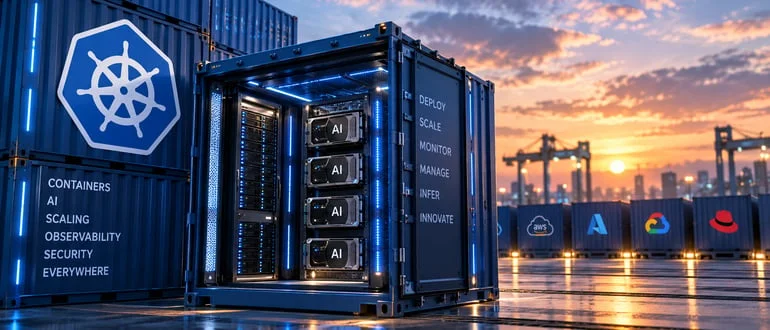
Transforming Legacy Systems for Real-Time AI: A Guide to Cloud-Native Modernization
Understanding the Shift to Real-Time AI
Organizations today face increasing demands for software platforms capable of real-time processing. Traditional systems, which operate on batch processing, must evolve to handle event-driven operations efficiently. This shift raises not just technical questions about model implementations, but also fundamental concerns about the architectural framework that supports these models.
Rethinking Migration Strategies
Transitioning legacy systems to the cloud is not merely a matter of lifting and shifting existing applications. Rather, an effective migration requires a thorough redesign of the underlying architecture to facilitate real-time capabilities. Merely moving to a cloud infrastructure could enhance flexibility; however, without addressing the systemic limitations of legacy designs, organizations will struggle to achieve the responsiveness needed for real-time AI.
Embrace Event-Driven Architectures
Batch processing may suffice in certain situations, but AI systems thrive on events—changes in customer behavior, transactions, and operational metrics. By shifting to an event-driven model, services can publish significant changes, with downstream components subscribing to these events. This approach allows for streamlined decision-making processes, comprising:
- Event: The occurrence prompting the flow.
- Context Enrichment: Enhancing event data with relevant information.
- AI Inference: Leveraging models to generate insights.
- Decision Logic: Determining appropriate responses.
- Business Action: Implementing the decision.
This model minimizes polling, allows for component scalability, and necessitates adopting robust strategies for event handling, including ownership, governance, and error management.
Decoupling AI Inference from Application Logic
Directly embedding AI models within applications can facilitate rapid prototyping, but it hinders scalability and adaptability as models evolve. By treating inference as a distinct service, organizations can establish a stable interface with their applications—allowing for easier updates, controlled rollouts, and independent scaling. This separation enhances transparency regarding model performance and failures, providing clearer metrics for measurement.
Establishing Real-Time Context
Real-time AI isn't just about speed; it's about context. Effective decision-making hinges on access to current and relevant data, encompassing historical trends, live user interactions, and operational powers. Therefore, architects must leverage cloud-native capabilities to integrate low-latency databases and real-time processing services tailored to the data that impacts immediate decisions.
Careful System Decomposition
The microservices approach can foster ownership and scalability, but indiscriminate decomposition can lead to added complexity, such as increased latency and failure rates. Targeted separation of functionality—such as event ingestion, context processing, and decision-making—ensures that each component can evolve independently while maintaining necessary connections.
Optimizing Operations with Kubernetes
Kubernetes offers a spectrum of operational advantages, from effective resource management to service discovery. However, simply containerizing applications does not inherently confer a cloud-native architecture. Successful deployment requires an understanding of effective service boundaries, async communication, resilience strategies, and observability embedded in the design.
Anticipating Failures
Given the unpredictable nature of distributed systems, anticipating component failure is essential. Employing timeout mechanisms, retries, circuit breakers, and idempotency should be a part of design principles from the start. Organizations should aim for resilience, not just within individual services, but across the entire business process to ensure operational continuity even in adverse conditions.
Integrating Observability
A sophisticated AI platform will move through multiple stages in real-time decision-making—from API gateways to downstream applications. Comprehensive observability, encompassing metrics, logs, and distributed traces, is critical for diagnosing issues effectively. Teams must also monitor AI-specific metrics—such as prediction accuracy and model drift—to ensure intelligence operates as intended.
Implementing Governance Mechanisms
As AI capabilities become integrated into operational processes, governance needs to be an intrinsic aspect of the architecture, not just a set of protocols. A well-designed architecture must include systems for tracing model predictions back to their origins, including the context in which they were generated and the business rules applied.
Gradual Modernization of Legacy Systems
Complete system overhauls are unrealistic for most enterprises. A more feasible strategy involves gradually exposing legacy interfaces via APIs and integrating new cloud-native services around existing functionalities. This phased approach allows organizations to incrementally embed real-time and AI capabilities while minimizing disruptions to ongoing operations.
Conclusion: Shifting the Mindset
Successful migration to a cloud-native model for real-time AI hinges on moving beyond simply asking, "How can we move this application to the cloud?" Instead, enterprises should consider how systems need to operate when intelligence and immediate decision-making become central to their business processes. This perspective is fundamental to achieving a truly transformative cloud-native architecture.