April 2026 Security Alert: Prioritizing High-Impact Vulnerabilities
In April 2026, the Insikt Group identified 37 critical vulnerabilities warranting immediate attention, with 35 of these registering a Very Critical Recorded Future Risk Score. This marks a notable 19% increase compared to March, emphasizing a growing trend of significant risks within enterprise environments.
Understanding the Vulnerabilities
A significant 31 of these vulnerabilities are also listed in the US Cybersecurity and Infrastructure Security Agency (CISA)’s Known Exploited Vulnerabilities (KEV) catalog. This overlap is alarming, as it indicates that many of the exploited weaknesses are already recognized by a government body as targets of active attacks. Interestingly, six additional vulnerabilities, identified solely through honeypot data, are restricted to Recorded Future customers. This exclusivity points to the complexities of vulnerability management and highlights a potential gap in the awareness of threats outside of this circle.
The vulnerabilities impacted products from 23 distinct vendors, with Microsoft representing about 22% of the total exposure. Microsoft’s large footprint in various sectors amplifies the impact of these vulnerabilities, as countless businesses and public institutions rely on its applications. The remaining risks were largely distributed among various enterprise vendors focusing on security tools, application delivery, remote support, and network infrastructure. The variety of products involved illustrates the wide-ranging nature of threats and how attackers often take advantage of systemic weaknesses across platforms.
This month, the Insikt Group developed Nuclei templates to address authentication issues in Nginx UI (CVE-2026-33032) and Marimo (CVE-2026-39987), which are available exclusively to Recorded Future customers. These templates are essential for quickly identifying and mitigating vulnerabilities, but the limitation on their availability raises accessibility questions. Many organizations might benefit from such resources, but without them, they risk prolonged exposure.
Vulnerability Reference: April 2026
Below is a table featuring 31 vulnerabilities that were actively exploited in April 2026, excluding the six associated with honeypot activity. It also includes public proof-of-concept (PoC) examples identified by Insikt Group®. Users should validate PoCs before testing.
Score
✓
(available to Recorded Future customers)
Table 1: Highlights of vulnerabilities exploited in April, including data from Recorded Future (excluding honeypot-linked CVEs).
Key Trends: April 2026
- Of the 37 vulnerabilities identified, seven were connected to ransomware activities. This statistic can't be ignored, as ransomware incidents have increased dramatically over the past few years, posing a serious threat to organizations across sectors.
- Six of these are associated with the Medusa ransomware operated by Storm-1175. This putrid group is known for their ruthless tactics, making their association here particularly concerning.
- CVE-2026-41940 was also linked to known ransomware incidents, confirmed by open-source reports. If you’re working in this space, vigilance is a must.
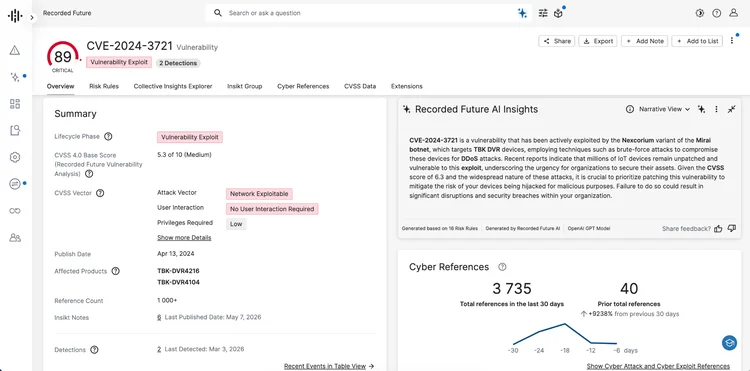
- Moreover, CVE-2024-3721 was exploited in TBK DVR devices to introduce the Nexcorium botnet. This is where things start to get risky for end-users and enterprises alike, as compromised devices can be repurposed for broader attacks.
- A total of 16 vulnerabilities enabled Remote Code Execution (RCE), affecting a dozen different vendors including Adobe, Fortinet, and Microsoft. RCE vulnerabilities are particularly worrisome because they can give attackers extensive control over affected systems. And yet, organizations still struggle to patch these vulnerabilities swiftly.
- Insikt Group reported public proof-of-concept (PoC) exploits for 24 out of the 37 vulnerabilities mentioned in this report. While PoCs can help illustrate the impact of vulnerabilities, they also risk escalating the threat landscape as bad actors can use them as launching points for their exploits.
- Common vulnerabilities featured this month were CWE-22 (Path Traversal), CWE-94 (Code Injection), and CWE-20 (Improper Input Validation). These categories reflect a persistent weakness in basic security practices. Attackers are savvy; if organizations can't cover the basics, vulnerabilities will be exploited time and time again.
- Three vulnerabilities date back over five years, with the oldest around seventeen years, underscoring that attackers exploit long-standing weaknesses in slow-to-patch environments. The quickest observed exploitation time from public disclosure was just two days. This rapid exploitation reveals a critical flaw in many security protocols. Too many organizations are slow to mount a defense against threats, which allows attackers a free pass into compromised systems.
Exploitation Overview
This section discusses certain high-impact vulnerabilities actively exploited, focusing on those tied to known threats, available PoC exploits, or those for which Insikt Group has generated Nuclei templates for detection. Vulnerabilities lacking substantial technical detailing are summarized in the disclosures table. If you're one of the system administrators responsible for patching these vulnerabilities, you should pay close attention to how quickly threats evolve.
Nexcorium Botnet Campaign and TBK DVR Exploitation (CVE-2024-3721)
On April 17, 2026, FortiGuard Labs published an analysis linking the Nexcorium botnet to vulnerabilities in TBK Digital Video Recorder (DVR) systems, specifically CVE-2024-3721. This OS command injection vulnerability allows remote attackers to execute arbitrary commands on compromised DVRs. Hackers target such devices because they often lack robust security measures, making them ripe for exploitation.
The campaign exploits this vulnerability using crafted requests manipulating specific arguments within the TBK DVR system. The process begins with a downloader script that retrieves Nexcorium binaries, which are then executed on compromised systems. Hackers thrive on exploiting users' inertia regarding patch management, and this case exemplifies how a single weak link can create extensive security problems.
Additional technical insights related to this activity, including sample analysis and Indicators of Compromise (IoCs), are accessible to Recorded Future customers. This advantage provides customers with an upper hand, but the broader cybersecurity community still faces challenges. Preventative measures and cross-sharing information about threats often lag behind adaptive attack methods.
Recorded Future clients can also utilize Malware Intelligence queries to discover samples linked to known network indicators. Being proactive requires diligence and investment in threat intelligence — something that all organizations should consider essential.
Implications and Future Outlook
The growing trend in exploit activity highlights a significant shift in cybersecurity dynamics. If organizations do not adjust their risk management strategies, they could fall victim to increasingly sophisticated attack methods. This isn’t just a technical problem; it’s a cultural one that requires attention from all levels of an organization.
With recorded vulnerabilities dating back several years still being exploited, it's painfully clear that many organizations face challenges in patch management and threat awareness. The trend of faster exploitation following disclosure coupled with a rise in ransomware incidents means that companies must reconsider their response times. Just assuming that patch management is enough is a dangerous gamble.
There's a pressing need for continuous employee training, investment in threat intelligence, and comprehensive incident response plans. As reported vulnerabilities remain high and evolving, this ongoing effort shouldn't be an afterthought but rather a priority for those looking to safeguard their operations. And this is the part most people overlook. The multi-faceted approach will ultimately determine whether organizations can stay ahead of cyber threats.