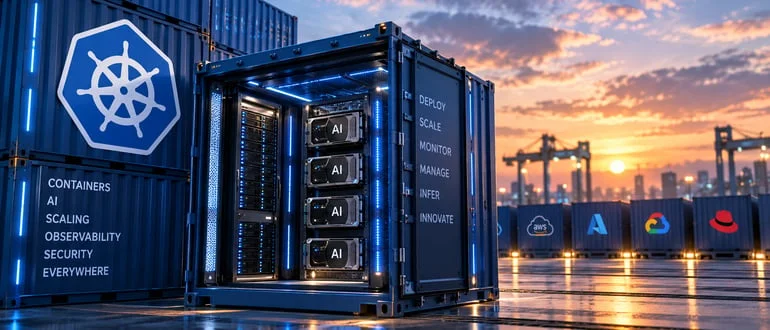
Optimizing AI Agent Orchestration through Cloud-native Engineering
In the realm of enterprise AI, the conversation often centers around the capabilities of models and the intelligence of agents. However, the real challenge many organizations face is not the sophistication of these models but rather the engineering hurdles associated with operating multiple AI agents in real-world environments. Transitioning from singular AI assistants to networks of specialized agents introduces complexities similar to those found in traditional distributed systems—issues that cloud-native engineering has addressed over the years.
Understanding the Challenges of Multi-Agent Systems
Multi-agent workflows are plagued by classic challenges inherent to distributed systems, including service failures, latency, and overburdened queues. As enterprises scale their AI capabilities, the need for effective orchestration becomes paramount. Each AI service must not only communicate reliably but also recover from failures, scale independently, and maintain operational security. Treating this orchestration process as a cloud-native workload has shifted from being a preference to a necessity.
Take, for example, a typical enterprise workflow involving several AI agents: one retrieves business context, another queries internal databases, while a third validates policies. A fourth might generate recommendations. The interdependencies among these agents can lead to multiple points of failure. Consider this: APIs could become unavailable, queues may back up, and the response times from downstream systems can vary unexpectedly. Without a resilient infrastructure, any one of these failures could cascade and disrupt the entire workflow.
Leveraging Cloud-Native Technologies
Containers present a consistent runtime environment for AI services across various stages, from development to production. Kubernetes further extends this consistency by automating critical tasks such as service scheduling, health checks, and rolling updates. This allows engineering teams to define the desired state of their services and rely on the platform to maintain that state rather than manually managing individual services.
Loose coupling among services is another important principle. Implementing event-driven communication enables agents to send messages asynchronously, reducing reliance on tightly woven request chains. This architecture enhances resilience by minimizing cascading failures and allowing for the independent evolution of services without negatively impacting the overall workflow.
Observability and Security Considerations
As the sophistication of AI systems grows, so must the methods for monitoring their performance. Traditional metrics, such as CPU usage and response times, are insufficient. AI systems require deeper insights into the whole operation, including prompt processing, model latency, decision-making pathways, and more. Techniques like distributed tracing equip engineers with the tools needed to identify failure points across complex agent interactions, while centralized logging simplifies incident response and troubleshooting.
Security must also be at the forefront of any cloud-native strategy. AI agents often interact with critical enterprise data, making robust security controls essential. Identity management, role-based access controls, and audit logging should be integral from the outset, ensuring that sensitive information remains protected as agents function across diverse environments.
Scalability and Future Directions
The ability to scale efficiently is yet another operational edge offered by cloud-native approaches. AI workloads can vary significantly throughout the day, requiring substantial compute resources during peak times. Automated scaling provides organizations the flexibility to adjust resources in real-time based on demand without incurring unnecessary costs through overprovisioning.
Platform engineering emerges as another vital aspect in effectively managing AI systems. Utilizing standardized deployment templates, reusable infrastructure components, and GitOps workflows allows for consistent delivery of AI capabilities across various environments, thus reducing operational overhead and enhancing governance.
The landscape of enterprise AI is evolving. The focus is shifting from simply deploying advanced models to ensuring the reliable operation of complex AI systems. Companies that integrate cloud-native engineering principles with their AI orchestration strategies will find themselves better equipped to develop scalable, observable, resilient, and secure business applications. While models contribute insights, cloud-native architecture serves as the essential backbone that enables those insights to translate into enduring business value.