Kubernetes Gets Serious About AI Scale, GPU Scheduling, and Agent Control
Kubernetes’ next AI push targets GPU efficiency, massive clusters, and safer agents.
Most people underestimate how much AI runs on Kubernetes. In the CNCF’s January 2026 Annual Cloud Native Survey, 66% of organizations hosting generative AI models said they use Kubernetes for inference. Add the teams running other AI workloads on it, and a clear majority of AI users depend on the platform. So the changes previewed at KubeCon North America 2026 matter well beyond the usual conference hype. The pitch was simple: keep AI productive while squeezing more out of existing cloud infrastructure through smarter scheduling, bigger control planes, faster container startup, and tighter control over autonomous agents.
Fixes From Production, Heading Upstream
Mike Stefaniak, AWS’s Head of Containers, put the core problem bluntly in his keynote: “AI workloads can spin up 10s of 1000s of GPU instances per cluster, and things break at that scale.” His answer was to push fixes discovered in enormous production deployments back into open source rather than leave them sitting in a provider’s private fork. That's the right instinct, and it's become a more visible pattern across the project.
AWS’s push beyond Kubernetes’ conventional 5,000-node design envelope, toward 100,000 nodes, surfaced several bottlenecks. In a million-Pod benchmark, an API-server watch-cache lock left writers waiting more than half a second. A lazy-snapshot implementation cut that wait to two milliseconds. Other changes removed serialization in Horizontal Pod Autoscaler processing and replaced repeated scheduler volume-reference calculations with incremental updates. Stefaniak reported scheduling rates above 300 Pods per second under sustained backlog in AWS’s largest clusters. He said those fixes have already shipped in Kubernetes 1.37.
Looking at 1.38, AWS co-authored a proposal to compress API objects before they're written to etcd, the data store that backs Kubernetes. “It’s accepted for 1.38 alpha, and the first code was actually merged just last week,” Stefaniak said. The immediate target is storage pressure in very large clusters, which is exactly where you'd expect it to bite first.
Scheduling Whole AI Jobs, Not Single Pods
The more consequential shift is how Kubernetes thinks about distributed AI work. Instead of treating each worker as an unrelated Pod, the scheduler is moving toward treating a distributed job as a coordinated group. The gang-scheduling enhancement is heading toward stable status in Kubernetes 1.38, and the Workload and PodGroup APIs give the scheduler native primitives for these groups.
Why does this matter? A training job where only some workers fit can sit on expensive GPUs without making progress. Gang scheduling holds the group until its required minimum membership can be placed. It coordinates admission. It doesn’t promise that every container starts at the same instant, but it stops the cluster from burning money on half-built jobs.
The roadmap goes further. Topology-aware placement and CompositePodGroups are both targeting beta. Together they address communication-sensitive placement and workloads made of multiple coordinated groups, such as distributed training and disaggregated inference. Dynamic Resource Allocation (DRA) fills in the hardware side by describing accelerator capabilities and capacity more precisely. General-availability promotions are planned for partitionable devices, consumable capacity, fractional capacity ranges, and device binding conditions. That moves allocation well past counting whole GPUs, which is where most clusters still are.
Getting GPU Capacity Online Faster
GPUs aren't being neglected. Stefaniak said Karpenter now models devices on the instance types it can provision. That closes a gap between DRA’s device inventories and just-in-time node creation. “GPU capacity can scale from zero and be optimally placed,” he said. To be clear, this is Karpenter work rather than a Kubernetes 1.38 feature, but it's the piece that makes elastic GPU pools practical.
Container startup is the other bottleneck. AI images now reach tens of gigabytes, and parallel downloads just move the delay to unpacking layers. Stefaniak said an upstreamed parallel-unpack implementation, available in containerd 2.2, cut a 10GB image’s registry-to-node time from two minutes to consistently under 45 seconds in AWS testing. If you pay for idle GPUs while images unpack, that's real money back.
Agents Raise the Efficiency Question
Efficiency now covers agents, not just models. At the press briefing, Jonathan Bryce, CNCF Executive Director, framed the challenge plainly: “This is how do we take the same footprint, the same power consumption, the same set of hardware, and get more out of it.”
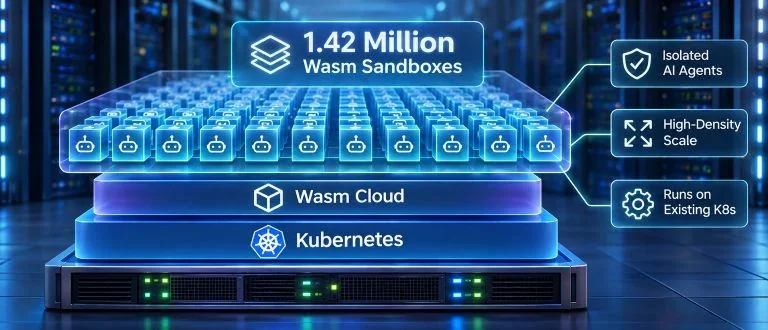
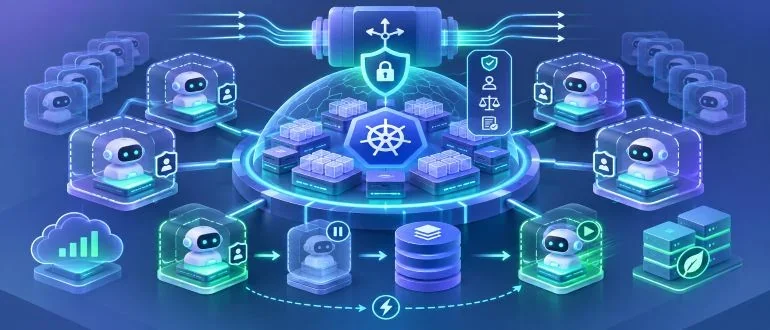
Bryce pointed to the default-deny approach to agent permissions in OpenShell, and to how Agent Substrate handles idle agents. He cited a demonstration that went from one agent per node to 65 by putting sleeping agents to sleep and scheduling working agents around their work. That's still work in progress, but the density gain is hard to ignore.
Portability is the unfinished layer. Dilpreet Bindra, VMware Senior Director of Engineering, said, “Our goal is to define and verify how workloads should behave across any environment, reducing the fragmentation and ensuring portability.” If that effort lands, teams won't have to rebuild AI pipelines every time they move between clouds and on-prem hardware.
The direction is clear: AI is forcing Kubernetes to coordinate workloads, hardware, and security as one problem. What ships in December still depends on the release process, and making these pieces behave consistently in production will take longer than a single release cycle. My read is that the payoff will be less about raw speed and more about getting more usable work out of the same clusters, which is where the money actually is.