Deep Dive into Kubernetes Networking: Unraveling Packet Flow and Connectivity
Jul 10, 2026
545 views
**Understanding Kubernetes Networking: Beyond the Basics**
Most guides on Kubernetes networking often simplify a complex subject by illustrating interactions with charming boxes and arrows: Pod A can easily communicate with Pod B. But here's the kicker: what actually happens in between those pods? Which components of the Linux kernel are tasked with ferrying packets? And how does a Service IP exist without a physical interface, yet still manage to route traffic effectively?
To pull back the curtain on the intricate workings of Kubernetes, I dedicated two weeks to dissecting packet flows within an operational cluster. Armed with tools like tcpdump, ip route, and conntrack, I traced packets through the networking layers, uncovering insights that transform a straightforward understanding of Kubernetes networking into a layered, detailed narrative of its inner workings. This exposition is about much more than theory; it’s an exploration complete with real packet captures and architecture diagrams to illustrate the Kubernetes networking dataplane, layer by layer.
For those of you managing Kubernetes in production environments, if you’ve ever found yourself lost in the labyrinth of connectivity issues, this breakdown will illuminate areas where intuition might have led you astray, replacing guesswork with targeted understanding.
### The Core Networking Principles of Kubernetes
At the heart of Kubernetes networking lie three immutable rules—guidelines that define how pods communicate without ambiguity:
1. Every Pod is assigned a unique IP address; there’s no Network Address Translation (NAT) between them.
2. Each Pod can connect to any other Pod, regardless of their respective nodes, without NAT complicating matters.
3. Agents on a node can freely communicate with all Pods residing on that node.
On the surface, these rules seem straightforward. Yet, ensuring they hold true requires precisely coordinated efforts across various Linux kernel subsystems throughout the cluster nodes.
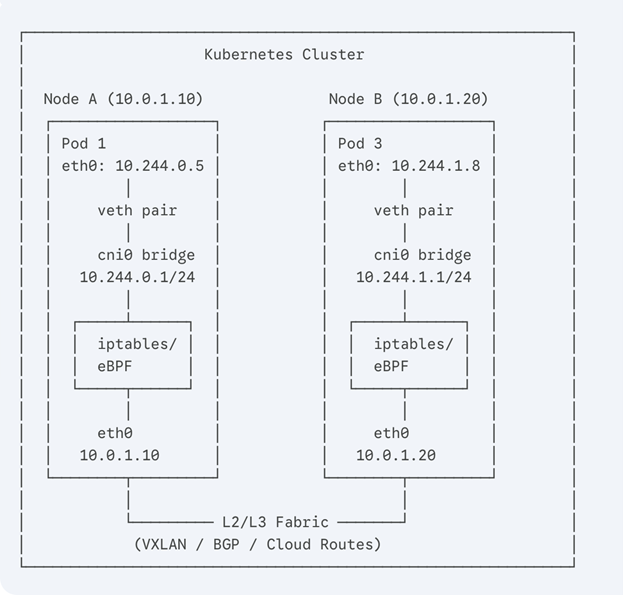
*Figure 1: The Kubernetes Dataplane architecture, illustrating the packet routing mechanism from Pod to Pod through the Linux Bridge and into the Layer 2/Layer 3 fabric.*
Let’s follow a packet as it traverses through the architecture.
### Packet Flow from Pod to Pod
Each Pod exists within its own Linux network namespace. This provides a distinct networking environment, including unique interfaces and routing capabilities. The connection from a Pod to its host Node is established through a virtual Ethernet pair (veth pair)—think of it as a virtual cable, with one end securely inside the Pod namespace and the other endpoint situated on the Node.
In real-world scenarios, understanding this connection is critical. For instance, consider the routing table inside the Pod. It has two clear routes:
- Traffic destined for local addresses (10.244.0.0/24) is sent directly via eth0.
- Other traffic is directed to the bridge at 10.244.0.1, effectively serving as the Node’s gateway.
As you delve deeper into Layer 2 interactions, the cni0 bridge works much like a virtual switch, linking all Pods within the same Node, enabling swift packet transitions without unnecessary layers of complexity.
### Real-World Applications and Debugging Insights
Picture this: Pod 1 at 10.244.0.5 sends a packet to Pod 2 at 10.244.0.6. Thanks to the bridge's Layer 2 lookup capabilities, this exchange is not hindered by routing delays, maintaining efficiency. The simplicity behind it? No NAT, no iptables involvement—just the straightforward movement of packets.
But what happens when packets need to cross Node boundaries? Enter the critical role of Container Network Interface (CNI) plugins, each offering different architectural strategies that can dramatically affect performance and protocol overhead.
For example, some systems might use encapsulation via VXLAN, leading to additional overhead, while others, like Calico, might favor native routing through BGP to retain optimal speeds. Understanding these paths is more than technical knowledge; it’s essential for effective scaling and managing Kubernetes services.
The implication here is clear: if you’re working in environments with extensive networking dependencies, knowing how these systems function on a foundational level is invaluable. It could mean the difference between resolving a networking issue efficiently or being stuck in endless cycles of troubleshooting without accurate diagnostics.
Kubernetes networking isn't just a black box; it's a finely tuned orchestration of Linux networking principles, where every packet carries with it a trail of logic rooted in the kernel. Understanding this architecture not only aids in debugging but also transforms how you approach Kubernetes networking as a whole. The next time connectivity falters, resist the urge to panic—start analyzing with tools that give you insight into where packets are dropping. The truth is often just a command away.The exploration of Kubernetes networking has revealed complex behaviors at layers 3 and 4 that are crucial for modern applications. Understanding these intricacies is more than just an academic exercise; for professionals navigating this space, it offers real-world implications.
Here's the takeaway: Kubernetes isn't just about container orchestration; the way it manages networking can significantly impact performance and scalability. If you're working with microservices, you'll want a keen grasp of how Kubernetes routes data packets. Misconfiguration or misunderstanding of these networking principles can lead to suboptimal application performance or even security vulnerabilities.
What’s especially telling is that networking in Kubernetes doesn't follow traditional models. The layering and abstraction can make it harder to pinpoint issues or optimize setups. It's not entirely clear why certain configurations yield unexpected behavior, leaving many engineers to troubleshoot based on incomplete information. It's essential to stay updated with evolving best practices and tooling in this area.
Looking ahead, the ongoing developments in Kubernetes networking technologies will likely drive more advanced solutions. As companies increasingly rely on cloud-native environments, mastery of these networking mechanics will determine bastions of success versus stagnation. This underscores the need for continuous learning and adaptation in the tech workforce, as the landscape is not static but rapidly changing.
For a deeper dive into how these networking principles apply in real-world scenarios, check out the full article [here](https://cloudnativenow.com/contributed-content/inside-the-packet-how-kubernetes-networking-actually-works-at-l3-l4/).