Recorded Future Introduces Automated Signature Creation to Enhance Vulnerability Management
Recorded Future has rolled out a compelling new feature: Automated Signature Creation. This advancement within its Attack Surface Intelligence (ASI) suite is designed to address the rapid evolution of AI-generated threats. The need for such a feature reflects an industry grappling with threats that outpace traditional defense strategies, indicating a shift towards smarter, faster cybersecurity solutions.
The ASI continually maps external vulnerabilities of an organization—an essential task in the current cybersecurity landscape. By correlating emerging threats with up-to-date intelligence, ASI enables security teams to prioritize their responses effectively. This proactive approach allows organizations to remediate vulnerabilities before they can be exploited, transforming the traditional security model from reactive to proactive. This evolution isn't just about keeping systems running; it's about safeguarding sensitive data and preserving organizational integrity against increasingly sophisticated attacks.
Automated Signature Creation specifically crafts detection signatures. These signatures are essentially rules that help the Recorded Future Platform identify known vulnerabilities across an organization’s assets in real time. The introduction of this capability streamlines the process of transforming threat intelligence into actionable defense mechanisms. In many ways, this is more significant than it looks—having the ability to automate signature creation can reduce the time it takes between detecting a threat and addressing it, thereby minimizing the potential impact of a successful attack.
Responding to the Fast-Paced Threat Environment
The tempo at which cybercriminals exploit vulnerabilities has significantly accelerated, fueled by advanced AI models that can now discover zero-day vulnerabilities in widely-used software, a feat once reserved for elite government and research teams. The ability to quickly analyze and exploit weaknesses is no longer confined to well-resourced entities. Rather, the democratization of AI capabilities has leveled the playing field, increasing the number of threat actors who can cause significant damage.
Historically, the window from discovery to exploitation has shrunk dramatically. A report from Gartner highlighted a drop from 45 days to just 15 days between 2010 and 2020 for this timeline. More recently, Recorded Future’s 2025 Malware and Vulnerability Trends report indicated that weaponization can occur within hours of vulnerability disclosure. Such statistics reveal a pressing issue: the speed of response required accentuates the inadequacy of traditional measures.
As cybercriminals evolve their tactics, the need for organizations to adopt flexible, automated, and real-time security measures has become paramount. Evaluating Recorded Future’s ASI enhancements demonstrates a necessary shift in how organizations need to approach vulnerability management to keep pace with AI-driven threats. If you’re working in this space, the implications are clear: standing still is not an option.
The Shift from Human-Curated to Automated Solutions
Previously, Recorded Future relied on manually crafted signatures from its Insikt Group®. While effective, this method operated at a comparatively slower pace, creating a dangerous lag in combating threats. In early 2025, an Analytic Report showed that expert-written signatures were employed to address vulnerabilities, such as CVE-2025-0994 related to Trimble Cityworks, indicating where defenders should focus their patching efforts. Yet, this slow approach fell short of the urgent demands posed by more advanced threats.
However, the rise of AI in exploiting vulnerabilities illustrates the pressing need for automation. Recently, OpenAI’s models reportedly triggered a zero-day exploit linked to the infamous Hugging Face incident, underscoring the importance of speed in the current threat landscape. Organizations quickly realized that by the time they manually crafted responses, the exploit could already be in play, undermining their defenses.
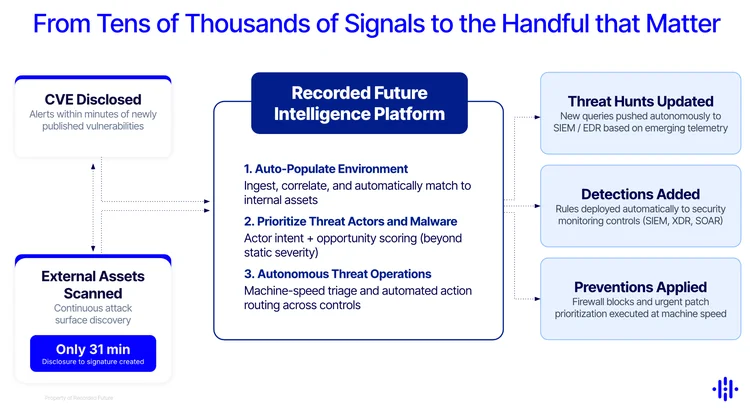
With the introduction of Automated Signature Creation, the platform can now autonomously generate production-ready detection signatures in as little as 31 minutes after a vulnerability is identified. This enhancement has led to a tenfold increase in the volume of signatures generated within the recorded backend. The shift from a reactive model to an automated one is a powerful acknowledgment of the reality that every moment counts in the cybersecurity arena.
Understanding Automated Signature Creation
So, what exactly does a signature represent in this context? Essentially, it acts as a specific detection logic—it's akin to asking an asset a precise question about its vulnerability status and receiving a clear, actionable answer. This clarity is critical when navigating the complex terrain of cybersecurity threats.
The Automated Signature Creation functionality operates through a three-step warning system:
- The platform maintains an ongoing inventory of what the organization is publicly exposing, including domain records, certificates, and relevant ownership data.
- Once a new vulnerability is detected, the system cross-references it with current asset data and analyzes real-time threat activity—not merely a static severity score. This ensures that the detection process is grounded in live exploitation evidence, correlating it with associated threats.
- If a CVE is deemed applicable for detection, the system swiftly processes it to craft a signature or product identifier within a remarkable timeframe of 31 minutes.
Implications and Future Outlook
The introduction of Automated Signature Creation carries profound implications for the cybersecurity industry. It positions Recorded Future not just as a participant but as a leader in redefining how organizations can manage their threat landscapes. However, it's essential to approach this advancement with a critical lens. Automation cannot entirely replace human intuition and expertise, especially in scenarios that require nuanced understanding and judgement.
What this means for you, the cybersecurity professional, is that while tools like this can enhance your capabilities, they must be integrated into broader security strategies that account for human oversight and intervention. The future likely holds more such tools that promise to streamline processes and improve response times, yet reliance solely on automation could lead to complacency.
In summary, Automated Signature Creation represents a significant leap in how organizations respond to vulnerabilities. As the threat landscape continues to morph, those who adapt will emerge stronger. But vigilance is essential.