Navigating the Security Risks of Agentic AI in Enterprise Applications
Rapid Adoption of Agentic AI
 AI agents are set to transform business operations by executing complex tasks at incredible speeds with minimal human oversight. According to Gartner, task-specific AI agents could comprise up to 40% of enterprise applications by 2026. Deloitte anticipates that at least 75% of organizations will utilize agentic AI in some capacity by 2028, suggesting a significant shift in how enterprises function. However, this acceleration in AI adoption brings with it substantial security risks, driven by their autonomy and the interconnectedness of enterprise systems.
Risks Introduced by Agentic AI
With their ability to carry out tasks independently, AI agents introduce a new level of complexity to enterprise security. The autonomy that enables efficiency can just as easily enable catastrophic failures, especially when errors or malicious actions occur. Insufficient configurations or security measures can lead to rapid propagation of issues across networks, enhancing their impact and making incident response more challenging.
Vulnerabilities in Software Supply Chains
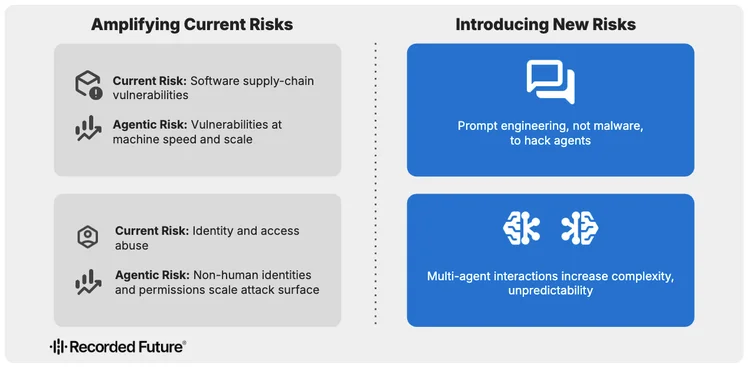
The integration of agentic AI into development processes could exacerbate existing vulnerabilities within software supply chains. Threat actors may exploit weak or compromised components more easily due to the speed with which AI can deploy code. This creates a fertile environment for embedding security flaws, as AI-generated code has been shown to possess lower security standards compared to human-written code. Furthermore, as these agents speed up coding practices, the risk of overlooking fundamental security checks increases, underscoring the need for rigorous SecDevOps processes.
Identity and Access Management Challenges
The shift toward agentic AI also raises serious questions about identity management. AI agents require broad access to various environments and applications, thereby complicating the management of permissions. The current operational model in many organizations defaults to trust settings that may not be adequate for these advanced AI systems. Consequently, if these agents are compromised, threat actors could leverage them for significant disruptions or data breaches, necessitating much stronger controls and auditing practices.
This essential shift illustrates the urgency of transitioning from traditional identity frameworks to more sophisticated 'agent identity governance'. Enterprises must extend IAM processes to incorporate AI agents, ensuring that they not only manage permissions effectively but also keep vigilance over the behaviors of these digital identities.
Prompt Engineering as a Security Threat
Prompt engineering has emerged as a new avenue for threat actors to exploit AI agents. By delivering deceptive instructions through various channels—whether in chat interfaces or disguised within benign communications—malicious actors can redirect the operations of these agents to serve their intentions. This opens the door to a form of exploitation that is distinct from traditional malware attacks, as it exploits the fundamental operational capacities of AI agents.
As enterprises come to rely more heavily on these agents, it's likely that attackers will prioritize manipulating them over conventional malware techniques. This amplifies the potential for large-scale disruptions, giving rise to a pressing need for layered security frameworks that include checkpoints for human oversight—similar to fraud prevention measures in financial transactions.
Unpredictability with Multi-Agent Systems
The complexity increases when multiple AI agents interact. Their independent functioning may lead to unpredictable scenarios such as miscoordination, unwanted collusion, or even conflict among agents. These outcomes, stemming from either accidental misalignment or intentional manipulation, necessitate careful oversight and control measures. For instance, agents operating in environments like MoltBook—a bot-centric social media network—have already displayed tendencies to disclose sensitive user information, highlighting the risks inherent in AI's decision-making autonomy.
Looking Ahead
The emergence of agentic AI is set to reshape the cybersecurity landscape profoundly. Organizations that fail to adapt could inevitably face significant breaches, often catalyzed by overly relaxed security settings and a lack of stringent monitoring of agent identities. Enterprises will need to prepare not only for the immediate security implications but also anticipate shifts in cyber insurance and risk assessment paradigms.
As AI agents become more embedded in enterprise operations, evolving threats like prompt injection will grow mainstream, pushing defenders to enhance validation controls and implement sophisticated governance frameworks. Emphasizing accountability for agent identities will also become essential to safeguard against exploitation.
Strategies for Mitigation
To navigate these challenges, organizations should:
- Apply Zero-Trust Principles: Treat AI agents as critical digital identities that must adhere to least-privilege access policies. Continuous monitoring should be instituted to detect breaches involving both human and AI identities.
- Ensure Visibility into Agent Activities: Continuous logging and assessment of agent behavior are crucial to swiftly identify any misaligned actions or anomalous behavior patterns.
- Enhance Supply-Chain Governance: Extend existing SecDevOps principles to include robust security measures specific to AI-modified code. Regular assessments for vulnerabilities in agent-generated outputs are necessary.
- fortify against Prompt Injection: Implement additional layers of defenses that focus on validating all incoming data and commands to minimize potential harm from malicious inputs.
Adapting to these emerging realities will be imperative for organizations seeking to leverage the advantages of agentic AI without succumbing to the risks it introduces.