North Korean Operators Exploit Job Platforms with Fabricated Identities
Executive Overview
Insikt Group has uncovered extensive deceptive activities linked to PurpleDelta, a network identified by Recorded Future as North Korean IT operatives, with many of them seemingly based in China. Between late 2024 and early 2025, these operatives inundated over 1,100 companies with job applications across sectors such as software, consulting, healthcare, and biotechnology. The operators utilized at least 22 fictitious personas, some enhanced with AI-generated images, ChatGPT-assisted communication tools, and counterfeit identification documents sourced from illicit providers. This sophisticated masquerade suggests they were likely employed by several organizations simultaneously, significantly amplifying the risk of insider threats.
The alarming scope of this operation is underscored by the sheer volume of applications; these operatives executed up to 60 job applications a day. This strategic manipulation included the use of multiple browser profiles to maintain control over their various false identities. They meticulously tracked their applications, employing screen recording software during interviews, often echoing the AI-generated responses they had been fed. After securing employment, they recorded internal meetings and used translated excuses to rationalize the use of personal devices and accounts for work-related tasks. Communication often happened over channels like Telegram and Slack, with at least two individuals facilitating the operations by managing access to company-issued hardware.
Such activities resonate with North Korea's broader tactics to harness IT workers for remote roles, raising significant concerns for organizations involved in remote hiring. Companies observing symptoms highlighted in Appendix A should initiate thorough reviews of employment histories and access levels of similar candidates, lest they fall victim to this extensive deception.
Key Insights
- Insikt Group's investigation reveals over 22 fabricated identities linked to various PurpleDelta clusters that submitted applications to upwards of 1,100 companies, focusing largely on software and healthcare roles.
- Evidence points toward these operators having secured employment in a minimum of ten organizations, mapping them as significant insider threats poised to compromise corporate confidentiality.
- The operational tactics of PurpleDelta reflect a high degree of sophistication, incorporating multi-account management systems and AI-generated visuals, along with real-time AI transcription tools. These elements serve not just to mislead hiring processes but to craft a detailed false narrative of qualifications.
- Post-hire, operators utilized screen recording technologies to capture internal discussions and crafted excuses using Google Translate for personal device usage, further blurring the lines between their fake identities and legitimate roles.
- Operations have shown that PurpleDelta affiliates employ identity services and manage multiple accounts, with coordination facilitated through Telegram and Slack, supported by facilitators who maintain their access to organizational hardware.
Background Context
PurpleDelta signifies the operational activities attributed to North Korean IT workers, a state-directed collection of covert tech laborers engaging on global freelance platforms and corporate recruitment channels. The group's existence exposes how state-sponsored cyber activities can co-opt legitimate workforce platforms for nefarious aims. This group is interconnected with other threat actor categorizations, such as Jasper Sleet and UNC5267, reflecting a networked approach to cyber operations targeting both private and public enterprises. The operatives masquerade as independent contractors and software developers to exploit remote job opportunities, where their profits are systematically channeled through multiple intercessors to fund the North Korean regime's military and nuclear ambitions.
These operatives assert multiple fake identities across numerous platforms, including GitHub and LinkedIn, creating a facade of credibility that makes them appear as legitimate candidates. Techniques employed involve the use of AI for fabricating comforting narratives, temporary phone services for communication, and advanced resume-building tools that simulate expertise. Insikt Group has also noted these operatives' connections to North Korean state-sponsored entities, with some indicators linking to malware deployment aimed at the software supply chain. This suggests an evolving threat landscape regarding information gathering and supply-chain vulnerabilities, extending well beyond mere identity fraud.
Threat Assessment
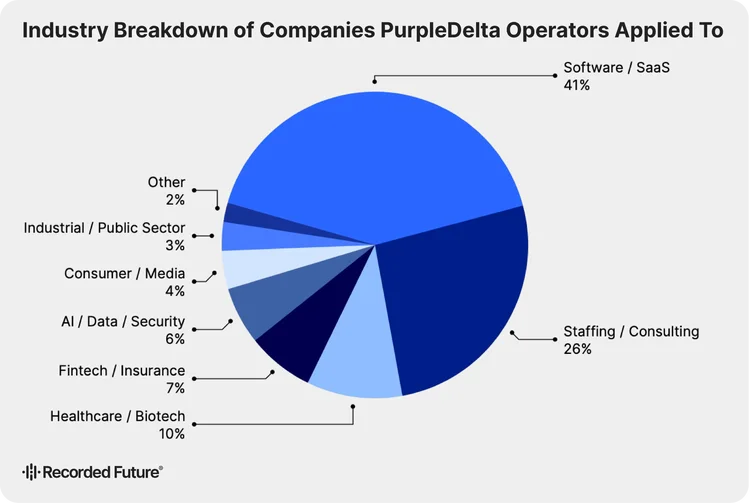
Insikt Group has documented various clusters of North Korean IT personnel since 2025, showing a strong likelihood of bases in China. They directed applications toward over 1,100 companies, with a significant portion — about 41% — in the IT sector, 26% in consulting, and 10% in healthcare and biotech. It's striking that the majority of these companies — around 80% — are based in North America, but applications have stretched internationally, with many operators linked to Shenyang, China, through their online profiles and digital footprints. This geographical focus signifies a well-coordinated approach, likely predicated on the tech industry's needs and vulnerabilities, creating a fertile ground for infiltration.
Implications for the Future
The implications of these findings extend well beyond the immediate threat posed by PurpleDelta. As organizations increasingly embrace remote work, they're also creating avenues for exploitation. A trend like this represents a fertile breeding ground for deception, pushing companies to fundamentally rethink their hiring processes. If you’re working in this space, it’s crucial to enhance your verification processes. Implementing stringent identity verification frameworks is no longer optional.
This isn’t just about preventing misuse of technology; it’s about safeguarding the integrity of your operations. Moreover, companies must anticipate the potential for rapidly evolving strategies from actors like PurpleDelta. As organizations move towards digital recruitment platforms, a more vigilant approach is essential. Organizations will need to be proactive in mental fortitude when faced with sophisticated threats designed to manipulate the very aspects of remote hiring they’ve adopted to stay competitive.