TAG-195 Enhances Malware Capabilities with Modular Design
Executive Overview
Insikt Group has uncovered four novel malware families developed by TAG-195, a financially driven malware-as-a-service (MaaS) entity. Dubbed "TinyEgg," "ChonkyChicken," a modular variant of ChonkyChicken, and "ChromEggscalator," these new strains reflect a significant shift toward modularity within the TAG-195 ecosystem. Previously, Insikt had linked TAG-195 to several operators, including TAG-127, which utilizes these new variants in targeted campaigns employing fake security pages to deploy malware. This evolution underscores the growing sophistication of cybercriminal tools.
The introduction of TinyEgg serves as a lightweight initial-access backdoor, offering capabilities like host profiling and interactive shell access. This initial access stage is critical, as it allows cybercriminals to gather essential data about potential targets before further engagement. In contrast, ChonkyChicken expands upon this by implementing features for browser credential theft and network reconnaissance, among other functionalities. The modular version introduces a controller-and-plugin architecture, allowing the base implant to load additional modules dynamically, rather than being burdened with all features from inception. This adaptive strategy not only enhances efficiency but also significantly complicates the detection effort for security teams. Moreover, TAG-195 has integrated a modified version of a publicly available Chrome encryption-bypass tool into their arsenal, named ChromEggscalator, which adds another layer of complexity to their strategies. This kind of modification hints at a proactive approach to dealing with security updates, something malware developers must do to stay relevant and effective.
The architectural advancements signal a transformative phase within the TAG-195 ecosystem. Insikt Group notes that this modular approach likely reduces the risk of detection for the primary implant and highlights commercial motivations typical of the MaaS model. By creating malware that can be tailored to a client’s specific needs, TAG-195 is making its products more appealing in a crowded market. This design facilitates selective capability provisioning, offers greater resilience in the event of a breach, and accommodates a variety of operational needs for clients. If you're working in this space, you need to realize how such adaptations can undermine traditional security measures.
Key Observations
- Insikt Group has identified four new malware families from TAG-195, suggesting ongoing development that emphasizes modular and operator-centric tools, which could represent a new standard in malware design.
- The modular ChonkyChicken variant employs a flexible architecture wherein a controller implant can request and activate at least fourteen functional modules on demand. This capability likely minimizes the exposure of the implant to static detection while aligning with specific intrusion requirements. It’s an approach that’s likely to evolve, making static defenses obsolete.
- All identified malware families exhibit consistent architectural features indicating a shared genesis within the TAG-195 ecosystem, including filename gating, persistent Run key entries, string obfuscation, and the use of standard Windows binaries for execution. These techniques suggest a well-organized development process and a commitment to refining their tools to evade detection.
Background Insight
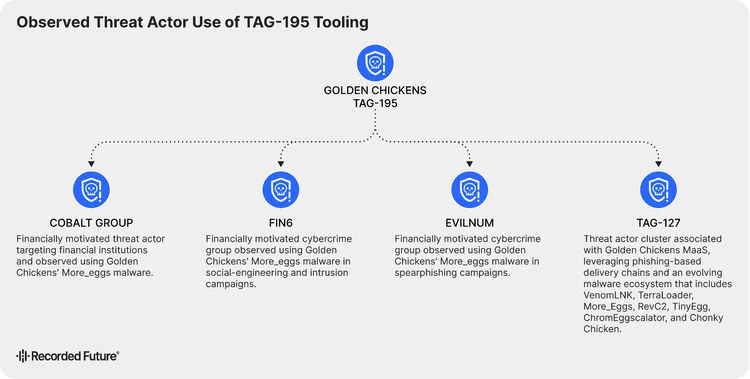
Known colloquially as “Golden Chickens” or "Venom Spider," TAG-195 operates as a financially motivated MaaS developer, delivering credential theft and remote access tools to various criminal operators. This reflects a shift in the strategies employed by cybercriminals, as they're increasingly turning to sophisticated malware that can be rented rather than developed in-house. The evidence of its tooling being utilized by multiple distinct threat actors positions TAG-195 firmly in the MaaS realm. Reports from eSentire have connected TAG-195’s offerings to criminal groups like FIN6, Cobalt Group, and Evilnum, which indicates a targeted market for its services—these connections showcase a network of organized and increasingly professional cybercriminals. However, the specifics of their pricing structures and access protocols remain largely obscure.
Interestingly, TAG-127 is recognized as a group employing the TAG-195 MaaS, frequently using ClickFix or VenomLNK delivery methods. This exposes a potential vulnerability in defending against these threats: if one actor can succeed with this toolset, others are likely to follow suit, leading to an expanding threat profile for organizations. Organizations need to recognize the evolving nature of these tools and be wary of their capabilities.
Implications and Future Outlook
The implications of these developments within the TAG-195 ecosystem are significant for both cybersecurity professionals and organizations at risk. This shift toward modular malware necessitates a reevaluation of existing security infrastructures. If attackers can adapt and customize their tools on the fly, it places additional burden on security teams to anticipate and mitigate threats in real time.
This evolving nature of malware also suggests a trend where future threats may become even more personalized and tailored to exploit specific vulnerabilities. Organizations must remain vigilant and invest in adaptive cybersecurity measures. Traditional one-size-fits-all approaches won’t suffice anymore. And yet, as these tools become more modular and potent, it raises ethical questions about accountability and the lengths to which security forces and organizations must go to defend against them. The situation only gets more complicated as bad actors become more sophisticated. Watch this space closely.
In a space where financial motivations drive innovations, cybersecurity remains an arms race. The ongoing development of these modular threats indicates that the battle against cybercrime will only escalate. Organizations committed to protecting sensitive information must not only adopt advanced security measures but also foster a culture of awareness among employees. What this means for you is that staying informed and proactive is more critical than ever.